

Drones drive enterprise geospatial shift beyond traditional surveys: Ankit Mehta, ideaForge
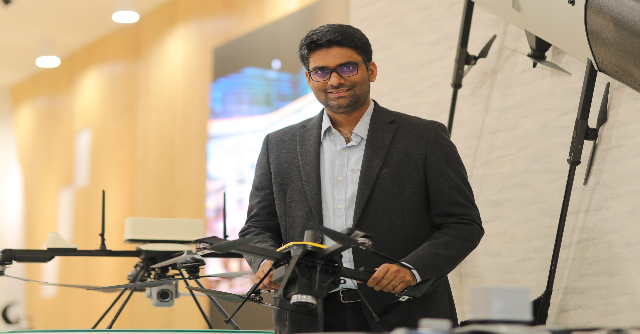
Drones are changing how enterprises capture and use geospatial data in India. High-precision UAV mapping is moving beyond traditional surveys, feeding into ERPs, GIS platforms, and emerging digital twin applications.
In a conversation with TechCircle, Ankit Mehta, Co-Founder and CEO of ideaForge, discusses the technological breakthroughs, operational challenges, and integration gaps that enterprises face as they adopt real-time, data-driven workflows.
Edited Excerpts:
What major technological shifts are driving the adoption of UAVs for high-precision mapping and intelligence today?
Over the past five years, India’s geospatial sector has undergone a major shift. The Swamitva scheme marked a turning point, as the government moved away from relying solely on traditional surveying and satellite data. Instead, it began using drone-generated data as a primary source.
The groundwork for this shift began about two years before the scheme’s launch. Once drone-based mapping entered the mainstream, the expectations for geospatial data changed in India and abroad. Satellite imagery with 30-centimetre resolution is no longer considered adequate, given that drones can capture data at 3 centimetres or less. This level of detail provides more precise, on-demand information about conditions on the ground.
This transition has reshaped how the industry operates. Conventional surveys are no longer the benchmark; drone mapping now drives most geospatial work. The clarity and accuracy drones enable make it difficult to revert to older methods.
The sector is now moving toward more advanced applications, including digital twins, detailed topographical maps, and automated analysis. Technologies such as lidar are being used to produce high-precision terrain data, supporting broader efforts to integrate geospatial information with AI and automation.
Do you see any barriers that still prevent public or private organizations from fully integrating UAV data into their decision-making workflows?
As with any new technology, early concerns often center on data acquisition costs and regulatory requirements. Since 2021, rules governing drones and geospatial work have been clarified, enabling broader creation of geospatial data.
Even so, drone regulations and operational rules remain basic entry barriers for many users. In addition, the government’s cost-sensitive procurement system often pushes providers to compete on price, which can reduce the quality of services delivered. When results fall short, the technology is often blamed, though the issue usually lies in the choice of service partner shaped by procurement constraints.
These factors can create a stop-start pattern in adoption. But the overall direction is clear: demand for higher-fidelity information is growing. In the short term, costs, service quality, and an immature market will continue to produce some friction. Over time, as buyers learn what quality standards to require, the system stabilizes, and the value of the data becomes clearer.
Achieving centimetre-level mapping accuracy depends on advances in optics, stabilisation and other technical areas. What major engineering breakthroughs have enabled this level of precision in recent years?
Large, high-megapixel, high-frame-rate sensors are now widely available. Their size and pixel density allow a single sensor to cover a broad area and record detailed imagery.
A second development is the use of PPK and RTK, which rely on GPS data to determine the drone’s 3D position with high accuracy. This improves the alignment between the drone’s recorded location and actual ground coordinates. Combined with ground control points, these systems enable precise positional and measurement data.
Processing software has also advanced. It can reconstruct 3D topography at faster speeds and with improved accuracy. These software gains are progressing alongside improvements in computing power.
Overall, data capture quality, positional accuracy, and processing capabilities have all advanced.
When we focus on India’s diverse environments—from dense urban areas to high-altitude regions—each setting presents different challenges. How do you balance endurance, payload performance, and imaging stability across such varied conditions?
Our work with defence customers has required us to build systems that function at high altitudes and in difficult environments. These projects demand consistent performance, which has led us to develop portable platforms that can be deployed in the field and carry out tasks under those conditions.
Developing high-performance platforms for defence gives us two outcomes: stronger performance and greater survivability. It also enables operations in high-altitude settings and in dense urban areas with tall structures, which present similar challenges. Addressing this requires algorithms and tools that use these capabilities effectively.
Together, these experiences have helped us expand our ability to map in any location. In the geospatial space, our aim is to reduce environmental and terrain constraints so operations can take place anywhere.
As AI expands into areas such as flight planning and automated feature extraction, which parts of the geospatial workflow are likely to gain the most from AI-driven automation in the near term?
AI-driven automation can support drone operations at several stages: operating the drone, collecting data, processing information, and analysing results. Its most effective use now is in two areas.
The first is a real-time assessment of data quality. This reduces the need for repeat fieldwork when poor data is discovered later. We have developed a payload that performs this check along with other functions.
The second is information analysis, which produces the outputs delivered to end users. Other steps in the workflow depend on factors outside technology. Automating operations requires regulatory approval. Automating processing requires AI systems that can deliver mathematically precise results. Current AI models rely on probabilities, which is acceptable in analytics—such as identifying whether an object is likely to be a person—but not in 3D data processing, where geometric algorithms must provide exact positions.
The most practical approach today is to ensure high-quality data capture in real time and to strengthen analytics, since that is what shapes the final output. Our system, Flight Cloud, is built around this idea: it moves data from the edge to the cloud and automates the stages from processing to analytics to reporting. This is where we see the most impact at present.
Given the large volumes of aerial data organisations handle, how do you expect the balance to shift between processing at the edge and processing in the cloud?
Edge systems will expand as long as they remain cost-effective. The more work handled locally, the lower the cloud costs. Still, storage and retrieval may stay in the cloud so data can be accessed from any location.
More activity will shift to the edge, but only up to the point where edge devices can support it. If large-scale processing power in the cloud delivers faster results, edge systems will not replace it. If that advantage is not possible, edge systems may handle processing tasks now performed in the cloud.
This shift could lower the overall cost of acquiring and processing data for operators.
As geospatial datasets become more sensitive, how do you handle the engineering side of data governance—specifically data integrity, access control, and the secure movement of machine data across devices and cloud systems?
Hosting systems on qualified infrastructure such as government cloud environments, along with enforcing access controls across all applications, is central to maintaining data integrity and security. Users must be isolated from one another, and standard cybersecurity practices must be followed. This includes monitoring for vulnerabilities and conducting regular tests.
At ideaForge, testing is carried out at the start of deployment. The company runs vulnerability assessments and penetration tests to confirm that the platform can securely handle user data. These steps help build user confidence.
End users generally respond well to this level of transparency. Effective security requires constant attention; there is no fixed solution. Strong connectivity and information access are necessary for any system to function, but neither should be assumed to be secure by default. Both must be managed together.
With growing interest in integrating drone data into enterprise systems like ERPs or GIS platforms, and considering your comments on digital twins, what gaps still exist, and how is the industry addressing them?
Digital twins are often discussed in terms of mapping the external structure of a site, but an effective model must also represent the internal layout of an organisation. How to build these internal models remains unsettled. Many locations cannot support indoor drone flights, and it is not yet clear whether robotic platforms, fixed camera systems, or other tools will become the standard method for capturing internal data. Each approach carries operational limits, and the field has not reached agreement on a reliable, scalable option.
A second unresolved issue is the pace at which real-world information can be integrated into a digital twin. Current systems operate in an early phase of adoption, and organisations are still determining how digital twins can support situational awareness and routine monitoring. The process of converting sensor outputs or other forms of measurement into a live, usable representation of a physical site remains slow and inconsistent. Improving that data flow—both in accuracy and frequency—will be essential for digital twins to function as continuous assessment tools. These questions will require more time, experimentation, and coordination across technologies before clear standards emerge.
Next Article