

Rewind 2025: Enterprise tech’s hits and misses in India
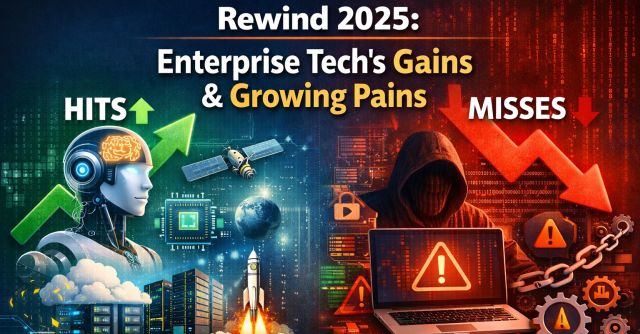
As 2025 draws to a close, India’s enterprise technology landscape reflects much progress and ambition, but also exposes clear gaps in execution. Companies embraced artificial intelligence (AI), cloud infrastructure and advanced digital capabilities with unprecedented urgency. Capital flowed freely, policy support deepened, and Indian IT firms pushed beyond their traditional comfort zones.
Yet multiple industry studies and expert assessments point to a familiar pattern. Execution gaps in AI strategies, cybersecurity readiness, data maturity, skills and operational integration tempered many of the year’s headline wins. Here's a roundup of the year’s enterprise tech hits and misses.
Hits: Bold moves and strategic wins
AI moves from pilot to priority
Artificial intelligence firmly moved to the centre of enterprise strategy in 2025. Indian companies, particularly in banking, IT services, retail and manufacturing, were quicker than many global peers to formalise generative AI roadmaps. Surveys consistently showed a majority of large enterprises now treating AI as a board-level growth and efficiency lever rather than an experimental IT initiative.
Banks such as HDFC Bank and ICICI Bank, among others, expanded AI use cases across fraud detection, customer service and credit assessment, while large retailers deployed AI-driven demand forecasting and personalised marketing. Importantly, expectations matured. CIOs increasingly linked AI investments to hard metrics—cost optimisation, faster decision-making and improved customer experience—rather than abstract innovation goals.
Governance, explainability and compliance climbed rapidly up the agenda. Enterprises realised that deploying AI at scale required clean data, clear accountability and robust controls. While hype remained, 2025 marked the year Indian enterprises broadly accepted that AI’s impact depends as much on process redesign as on algorithms.
Read more: Rewind 2025: India’s AI goes mainstream as enterprises scale from pilots to production
IT services firms signal confidence through M&A
India’s IT services majors used mergers and acquisitions to signal confidence in an AI-led future. Coforge’s $2.35-billion acquisition of US-based Encora stood out as one of the year’s defining deals, significantly boosting its AI-native engineering capabilities and expanding its presence in North and Latin America.
Other mid-tier firms followed suit with targeted buys in cloud consulting, data engineering and digital experience design. The strategy marked a shift away from incremental capability building. Indian IT firms increasingly chose to buy scale, domain expertise and specialised AI talent outright. The message to global clients was clear: staying relevant in the next decade will require deeper intellectual property, stronger platforms and closer alignment with core transformation agendas.
Read more: Rewind 2025: Top tech M&A deals in India
Data centres emerge as strategic infrastructure
Few trends captured India’s digital ambitions as clearly as the surge in data centre investments. With cloud adoption accelerating and AI workloads demanding massive computing power, data centres became mission-critical infrastructure rather than back-end utilities.
States competed aggressively for projects, offering land, power and policy incentives. Maharashtra and Tamil Nadu retained leadership, while Uttar Pradesh and parts of coastal Karnataka gained visibility by emphasising renewable energy access and improved fibre connectivity. For enterprises, the benefits were tangible—lower latency, better compliance with data localisation norms and faster scaling of AI systems. By year-end, it was evident that India’s digital economy would increasingly run on servers housed within the country.
Read more: India’s data centre reckoning: How power, land and AI redefined enterprise infrastructure in 2025
Semiconductor ambitions gather momentum
India’s semiconductor push progressed beyond rhetoric in 2025. Instead of chasing a single mega fab, the focus remained on building a broader ecosystem spanning chip design, packaging, testing and specialised manufacturing. Project approvals under the India Semiconductor Mission, particularly in Gujarat and Assam, reflected steady progress.
Global design firms expanded their India operations, while startups and engineering institutes benefited from renewed attention to hardware innovation. Though still early-stage, the momentum marked a subtle but meaningful rebalancing of India’s technology narrative, long dominated by software services.
Space technology reinforces strategic confidence
India’s space programme delivered a notable technical success with in-space docking experiments under the SpaDeX mission. Demonstrating docking and power transfer capabilities—key to future goals such as an Indian space station—reinforced India’s reputation for cost-effective, complex engineering.
While far removed from day-to-day enterprise IT, such achievements contribute to broader technological confidence, signalling India’s growing capability in high-stakes, precision-driven domains.
Misses: Execution gaps and rising risks
The AI execution gap widens
Despite strong strategic intent, large-scale AI deployment remained limited. Only a small fraction of enterprises reported that AI is fully integrated into their core workflows, with outcomes tied directly to business KPIs. Many projects stalled at proof-of-concept stages, trapped in what executives increasingly called “pilot purgatory”.
Weak data foundations, unclear ownership between business and IT teams, and underestimated deployment complexity proved to be common stumbling blocks. The gap between aspiration and execution emerged as one of the year’s defining contradictions.
Cybersecurity struggles to keep pace
Rapid digitisation significantly expanded the enterprise threat surface. High-profile cyber fraud incidents, particularly in the banking and financial services sector, highlighted how attackers continued to outpace defences. Even as boards approved larger cybersecurity budgets and prioritised governance, breaches and disruptions persisted.
The lesson from 2025 was uncomfortable but clear: digital scale without commensurate security maturity carries serious financial and reputational risks.
Infrastructure and talent bottlenecks persist
India attracted multi-billion-dollar commitments from global hyperscalers for cloud and AI infrastructure. Yet concerns lingered around power availability, data centre capacity and local capabilities for advanced AI model training. At the enterprise level, data quality, governance frameworks and skilled talent remained recurring constraints.
Technology investments moved faster than the systems and skills required to absorb them—limiting returns and slowing time-to-value.
Read more: Rewind 2025: India’s tech hiring turns inward, with fewer hires, sharper skills
Digital adoption stalls at the last mile
Beyond large enterprises, digital transformation among small and mid-sized businesses remained uneven. While many SMEs adopted cloud tools and enterprise software, deeper usage was held back by skill gaps, usability challenges and cultural resistance. Aligning global technology platforms with local business practices emerged as a persistent, underappreciated hurdle.
Cautious momentum into 2026
India’s enterprise technology story in 2025 was defined by confidence in direction but inconsistency in delivery. AI, cloud and digital infrastructure are now firmly embedded in boardroom strategy, backed by capital and policy support. The harder work—execution, security, governance and talent development—lies ahead.
If Indian enterprises can close this execution gap, 2026 could mark the point where technology investments begin translating into a durable competitive advantage. The revolution in Indian boardrooms is underway. Making it work at scale will determine who leads—and who lags—in the next phase of growth.
Next Article