

Faya's Deepu Nath on why AI needs a human reset
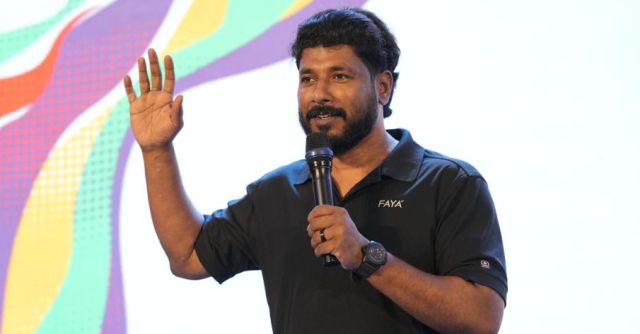
As artificial intelligence rapidly moves from pilot projects to the core of economies and institutions, the global debate has centred on scale, speed and competitive advantage. But according to Deepu S Nath, managing director of Faya India, the global technology arm of US-based Faya Corporation, a technology solutions company located in Trivandrum, the real disruption lies far deeper than technology.
“AI is not the revolution people think it is,” Nath told TechCircle. “Technology has always been a tool. The real question is whether it creates independent thinkers or reinforces obedience.” Without a shift in mindset, he argues, AI risks becoming another mechanism of control rather than empowerment.
At the heart of the problem, Nath says, is an education system built for an industrial economy that no longer exists. Designed to produce disciplined workers through memorisation and standardisation, it is ill-suited for an AI-driven world where machines outperform humans at repetitive cognitive tasks.
“The irony is that we’re still training people for exactly the kind of jobs AI is replacing,” he said. “The future needs critical thinkers, collaborators and creators, not just degree holders.”
Nath advocates moving learning beyond classrooms into peer-led communities where contribution matters more than credentials. Hackathons, open-source projects, side initiatives and collaborative networks, he says, offer learners practical exposure and proof-of-work that traditional education often lacks.
Job displacement from AI, particularly in India’s services-heavy economy, is already underway. Nath points to roles in BPOs, call centres and routine knowledge work as especially vulnerable. “The system moves on quickly when these jobs disappear,” he said. “Individuals are left carrying debt, insecurity and lost confidence.”
The bigger challenge, he argues, is not job loss itself but whether workers are being equipped to adapt through hands-on experience, problem-solving and continuous learning.
Globally, AI development remains concentrated among a handful of large corporations, recreating old inequalities in new forms. Nath warns that while ideas now matter more than capital, control is increasingly enforced through closed AI models, opaque data practices and artificial scarcity.
Bias in AI systems further compounds the issue, especially for the Global South. Nath notes that most AI models are trained on data that underrepresent large parts of the world, including India’s cultural and linguistic knowledge. As machine-generated content is recycled into training datasets, biased outputs risk becoming permanently entrenched.
AI’s environmental cost is another overlooked concern. Large models consume enormous energy through data centres and GPU clusters, even as climate action lags behind technological expansion. Nath argues that sustainability must be embedded into AI design rather than treated as an afterthought.
Despite the risks, Nath believes India has a rare opportunity. With strong digital public infrastructure, widespread internet access and a young population, the country starts from a near-level technological baseline with the rest of the world.
“India’s edge will come from mindset,” he said. “If we can turn students into contributors and classrooms into communities, AI can become a force for democratised intelligence rather than centralised control.”
If done right, he added, AI will not just transform work—but redefine how societies learn, collaborate and act responsibly in a connected world.
Next Article