

Accelerating Delivery of Large-Scale ERP Implementations Using AI Technologies
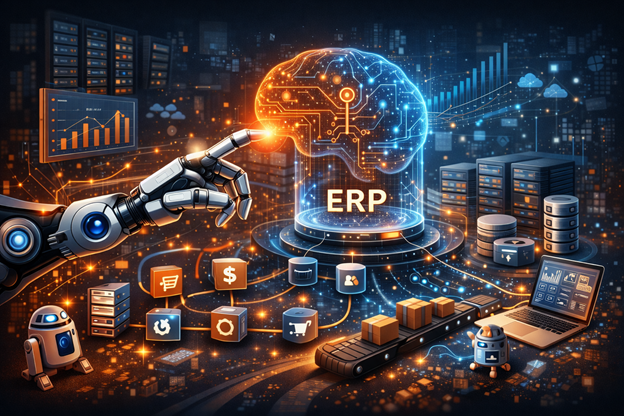
ERP implementation is not something that has recently been considered a trial and time-consuming venture. These are long-term (months/years) projects, they can require colossal resources and massive investments and dependence on a number of various departments is extreme. However, the new fast-moving and digital world has not given time to waste in the organizations. They desire to have scaling power systems and even ones that used to be in operation today. Here it is that the artificial intelligence encroaches in a creepy yet somewhat unhesitating way but never to ruin but to carry out the human aspect.
Why ERP Implementations Take So Long
The first question that we should answer in a bid to determine how artificial intelligence can help facilitate faster things is the reason why ERP rollouts are usually slow. Involved processes, stakeholders and the systems that are already in place in big-box ERP projects are listless. It is divided into data conversion, integration with the tools at the disposal of the company, data customization, and training of the people, post-implementation testing and support. The other stage is also allocated problems and requirements thereof. Project lifeline may obtain the theatres of the straightforward failure in the planning at a lower phase leading to expensive delays.
The manual works are also present in the traditional ERP implementations. This may lead to mapping of business processes to the point of finding data inconsistencies. The most widespread ones are human error, changing business needs and scope creep. To top it all, the challenge in matching the system to the business specifications requirements and it is no wonder that such projects never achieve their deadline.
AI: The Smart Shortcut That’s Not Cutting Corners
The artificial intelligence installation in the programs of the ERP is not simply connected with the spinsterhood and the ease of life. It’s about working smarter. The artificial intelligence devices have already reached their developmental phases and they can provide foresight, the automation of the operations that do not need input and the process of making the decision is reduced by much. To provide an example, it is possible to take a system, which not only can help in the identification of the points of delays, but also can present real-time solutions. This is what is being done by intelligent systems.
Automated process mining is one of the game-changers of this space. It involves the application of AI in processing event logs of the current systems to construct the actual business processes. This does away with the speculation during the design of the ERP implementations. The use of AI will make the decision-making process of the project teams more precise and quicker as it will be possible to present the existing operations in a clear and objective image. This spares untainted time of finding out and planning.
The Power of Predictive Analytics
The other implementation of the strength is the predictive analytics implementation of project planning and risk management. The AI-based solutions could be used to anticipate the bottlenecks and impose the delays in the timetable instead of responding to any issue that occurs. This form of proactive will help teams to allocate the resources more effectively and plan the schedule on an ad hoc basis. An example will be a predictive model where depending on similar projects that have been previously done, one can predict beforehand that a particular module will create delays and extra care and early experimentation can be made.
The budgetary and resource planning also have the same forecasting capability. The analysis of the information of the previous projects and the current information would allow the AI to predict the cost overruns and suggest the potential methods of mitigation in advance. On the insights, the teams are able to share quality with some speed, and avoid the pitfalls that are the order of the day in ERP projects.
Smarter Testing, Better Quality Assurance
Another activity that artificial intelligence can complete fairly well is quality assurance. Unlike the time when they were filled in by hand and adopted by different individuals, AI technologies are capable of creating tests automatically based on the requirements and the behavior of the system. These tools are also developed with time and become more accurate and faster with the course of the test. Not only does it make the QA process faster, but also the degree of acceptability of the ERP system when it is deployed.
Furthermore, the bots, developed based on the AI, would be capable of reproducing the conversation with the user and informing about the problems that would not have been revealed in the traditional testing. This means that the product that will be adopted will not only be adopted promptly, but also practically. Business organizations that do not require re-writing substantial bugs after posting them save enormous sums of money and time.
A Culture Shift That Can’t Be Ignored
Another thing is the use of AI and the technology itself in the implementation of ERP as a cultural change on how an organization embraces the change. It helps in flexibility, dynamic planning and informed decision-making. The tedious and analytical work does not burden the human teams as most of the gruff work is done by the AI and the human team is able to concentrate on other strategic activities. Such symbiosis association is not only accelerating the implementation of ERP, but computer maturity of the company in general.
It is possible that companies that have been through the ERP cycle and adopted the use of AI will end up having the unintended value. They are probably more swift, okay, but become more pliant and tougher. They are not serious enough to adhere to any changes in the market and they are in a better position to deliver on the potential of their enterprise systems.
Conclusion
It is not lumbering giants as it was the case in the large-scale ERP implementations. As the AI technologies will participate in the process of virtual implementation of all the rollout stages, including planning and testing stages, the training and the rolling out stages, the overall timeframes may be significantly reduced without the quality reduction. It is by no means to place the world to an end, and be where it is to way. Through clever application of AI, their ERP process can be fastened and a smarter and malleable system can be created that can exist in the future.
No Techcircle journalist was involved in the creation/production of this content.

Karan Shah
Next Article