

From Platform Engineering to Autonomous Enterprise Platforms: Embedding AI for Self Healing, Self Optimizing Infrastructure
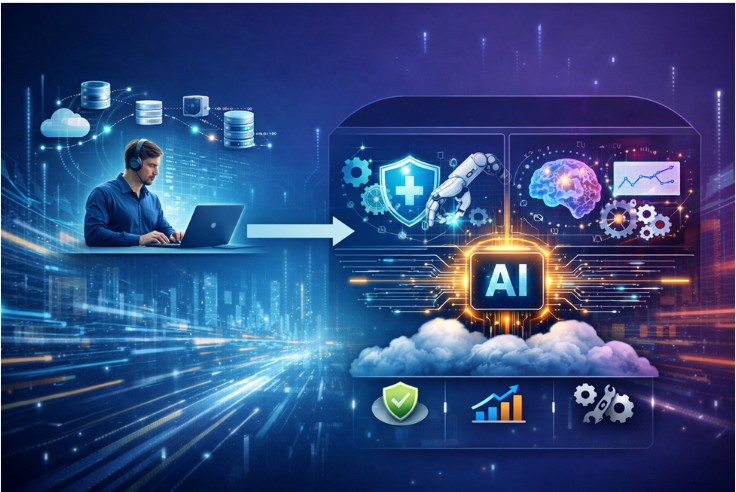
Transformations in technology in an enterprise occur in waves. Virtualization enabled resources to become more efficient, the speed of scaling was enhanced in the cloud, the speed of delivery was enhanced with the help of DevOps, and unified developer experiences were deployed at
the platform engineering level. Another change that is emerging is autonomous platforms.
It is not about replacing engineers. Of interest is the mitigation of the vicious cycle of firefighting that burns resources and time. This is built-in intelligence in infrastructure, which implies that systems are able to anticipate issues, save resources, and correct themselves without someone receiving a two-in-the-morning notification.
The Limits of Traditional Platform Engineering
Platform engineering already represents a paradigm shift in terms of software development and work. Infrastructure as code, self-service environments, observability, and policy-driven governance have allowed developers to have a steady runway for innovation. Complex
infrastructure can be provided in a few minutes rather than weeks. Guardrail constructions are created through templates. Compliance is not peripheral.
However, even the most advanced platforms are reactive in character. Scaling decision-making is usually a reaction to a crossed threshold. Symptoms are seen only after incidents have occurred. Teams continue to look through logs and traces to identify what has gone wrong.
Broken pipelines are targeted by data engineers. In a cloud environment, cost and performance balancing are done manually by operations teams.
Since the systems are distributed, the amount of signals is so large that humans cannot handle them in real time. The second item that is not included in dashboards is autonomy.
From Reactive Automation to Intelligent Infrastructure
Classical automation contains predetermined rules. Autonomous infrastructure acquires patterns. As an example, a business case can be that an enterprise platform can automatically scale workloads before business spikes and automatically reuse idle resources and deployments
both in the cloud and on premises based on performance, cost, and compliance needs.
It is not a monodimensional intelligence. Workloads may be deployed either on-premises or in the cloud depending on cost, performance, and compliance needs. Unused resources are automatically reclaimed and reused. Access patterns are dynamically learned at the storage-layer level. Dynamic infrastructure is defined by real-time learning rather than pre-programmed configuration.
It is a self-optimizing platform. Switching on a setting does not improve it; instead, it belongs to a constant process of learning through telemetry and modifying itself.
Predictive Observability and Self Healing Systems
Observability has never had issues with visibility. Insight transcends physical sight and becomes foresight. Rather than relying on alert messages, intelligent systems analyze logs, metrics, and traces collectively in order to track minor trends that indicate the onset of a problem. The latency of a particular service can be delayed by a bottleneck in a database. The platform can intervene in advance, and users may not even be aware that it has inferred such a relationship.
When the latency of one service increases, this could be an indication of an upstream dependency problem. The platform can take corrective measures, such as restarting non- functioning containers, diverting traffic, or automatically rolling back problematic releases instead of merely responding to an alarm.
This is pure self-healing. It reduces downtime and recovery time, and it allows operations teams to focus on overall system improvement instead of individual remedies.
Agentic Intelligence Across the Enterprise
Autonomous platforms do not rely on the principle of a single model, but on the principle of cooperating intelligent agents. Some pay attention to the quality of data and trace pipelines to find anomalies and modify them accordingly. Others are concerned with infrastructural performance optimization of queries and workloads. Governance agents identify drift as it happens and take action to intervene with compliance risks. Cost management agents try to find ways in which they can eliminate waste without compromising the quality of the service.
The result of such agents is a unitary level of control. They are in the same context, and they have memory in common. They are founded on the history of events that occur and give recommendations depending on the effects on the business. The platform does not simply show you what has gone wrong, but what happened, why it happened, and probably what will happen next.
This is not blind automation. It is contextual decision support, and it gets smarter over time.
Governance Without Friction
Uncontrolled speed is not safe. Governance is entrenched in autonomous business foundations. Policies are diffused through infrastructure templates and verified on a continual basis. If security or compliance policies are non-existent, the non-secure and non-compliant
environment is automatically corrected or restored to a compliant state.
It is a responsible and open model. Self-service environments are offered to developers. Executives are assured they will not be punished for innovating against regulatory or financial requirements. Governance is proactive as opposed to reactive.
A Gradual Path to Autonomy
Autonomy does not ruin existing systems. It is implemented in stages. This starts with infrastructure optimization and visibility of the data. This is then followed by smart diagnostics to enhance the speed of fault detection. Then there is guided remediation, wherein systems must keep human beings in the loop in order to develop a remedy. Full autonomy and automation are then implemented for routine problems so that teams can concentrate on big-picture issues.
This transformation is anchored on actual indicators. Examples of measurable value include decreases in the number of hours of manual handling, reductions in mean time to resolution, improvements in data accessibility, and reductions in cloud costs.
The Rise of the Adaptive Enterprise
There is no mere technical phenomenon in using a self-managed enterprise platform. It is a revolution in the manner of doing things. Infrastructure is no longer a passive platform. It is transformed into a multimodal ecosystem capable of storing usage patterns, predicting
business requirements, and aligning technology choices with business strategic plans.
The world is dynamic and complex enough that having as many dashboards as possible cannot make businesses successful. They will succeed when they manage their platforms optimally.
There will be reduced time spent on engineering troubleshooting and increased time spent on innovation. Leaders will be able to make bold choices. Customers will not be inconvenienced as much.
Platform engineering is the new tier of enterprise platforms. It is not whether systems can be trained to work without the functions of human beings. The possibility of adopting autonomy is already a thing of the past, but how fast can organizations be ready to adopt autonomy in a
responsible manner?
NOTE: No TechCircle Journalist was involved in the creation/production of this content.

Nithish Nadukuda
Next Article