

Designing Cloud Native Integration Solutions with Azure API Management and Event Grid Focus
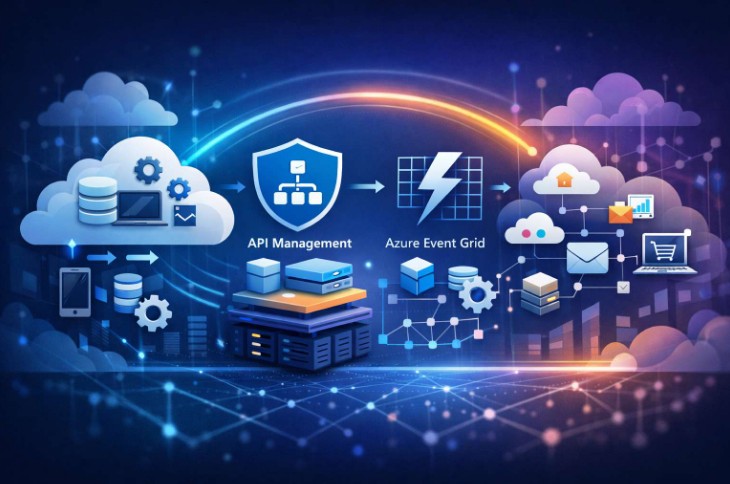
Today's software applications are no longer monolithic. They're decentralized, scalable, and constantly evolving. This evolution to cloud-native development brings with it new considerations, particularly around how parts of the system communicate and work together. Integration is no longer focused solely on connecting systems, but on how they interact in a way that is fault-tolerant, performant, and flexible.
In the cloud-native world, services must be able to scale out, fail over, and communicate with minimal coupling. This is where integration solutions must evolve. Instead of systems communicating solely via request and response, they increasingly use asynchronous, event-
driven communication. So rather than services continuously polling for events, they simply react to the event.
The Role of Event Driven Architecture
Event-driven architecture is the key to cloud-native integration. This enables services to interact by sending events, or messages that describe something has occurred. Rather than blocking and waiting for a response, systems can continue to function while other parts of the system
respond to events.
This makes the system less susceptible to failure. For instance, if a service is temporarily unavailable, the rest of the system can carry on and deal with the event when the service becomes available. This results in a fault-tolerant environment. It also increases scalability, as
services are not directly dependent on each other and can be scaled up and down accordingly.
Event-driven architecture also avoids the waste of time and resources in polling. Services don't poll to see if something has changed; they are notified when it does. This boosts performance and efficiency.
Leveraging Event Grid for Seamless Communication
Event Grid is a key part of event-driven integration. It provides a publish-and-distribute event routing service. In particular, it is capable of efficiently handling individual events and is therefore well suited to scenarios where services respond to specific events. Another important feature of Event Grid is the adoption of a standard event format. It enables services to consistently manage data. This simplifies integration and reduces the need to create custom communication methods.
Events include required data such as the event's source, type, timestamp, and the event payload. This allows event subscribers to filter and respond to events of interest. This allows systems to be loosely coupled while still being able to communicate.
Designing Effective APIs for Integration
Events are used for asynchronous communication, but APIs are needed for synchronous communication. We need to design for integration. APIs need to be platform-agnostic and forward-compatible, so they need versioning and backward compatibility to enable evolution.
It's important to design an efficient API. It should be natural to use and should not be unduly complex. It should also allow filtering and pagination to efficiently manage large volumes of data.
Stability and traffic control are also critical issues. This is where an API management layer comes into play. This can control traffic and maintain stability, especially when systems are very busy.
Achieving Loose Coupling and Scalability
Hard to miss about cloud-native systems is the loose coupling. This means that services are self-contained, and changes to one part of the system don't require changes to other parts. To do this, we need to be careful about how we communicate between services and how we handle data.
Loose coupling is also achieved using event-driven, asynchronous communication. This allows services to respond to events independently of the inner workings of other services. Scalability refers to the capacity of cloud-native apps to grow according to the needs of varying loads. To
create this flexibility in the design of the application, developers design stateless services (as opposed to stateful services) and utilize shared databases and caches. These techniques allow cloud-native applications to easily grow and scale horizontally in their architecture.
Building Resilient and Future Ready Solutions
Planning for failure is an important aspect of building a resilient cloud-native integration solution, since distributed systems fail. In distributed systems, you can implement retries and circuit breakers to ensure that you don't lose data or compromise your system's integrity due to either transient or permanent failures.
Security is also a major aspect of cloud-native integration solutions. You must put in place authentication and authorization protocols for exchanging data between your cloud services to ensure that only trusted components are exchanging data with one another. This is in line with
the zero-trust philosophy; therefore, you need to assume by default that you do not trust anything.
Flexibility, performance, and reliability are all very serious concerns when it comes to developing cloud-native integration solutions. When you implement event-based messaging and robust API design, you will not only create efficient systems but flexible systems as well, enabling your system to adapt to and continue evolving with new ways to design and innovate.
NOTE: No Techcircle journalist was involved in the creation/production of this content.

Sukesh Singuru
Next Article