

Designing Revenue Operations Systems for Scalable Growth
One of the challenges faced by modern businesses is the disconnect between marketing and sales. Both departments often work independently and set unrelated targets that do not focus on achieving synergy in delivering the best possible customer experience.
This disconnect has negative consequences for growth and results in lost opportunities. By rethinking how you operate your Revenue Operations System and coordinating all revenue-generating activities under one system, you can eliminate these disconnects and create synergy across all teams. Instead of working in silos, teams operate in a unified manner, with a shared focus on common outcomes.
This change is not only structural; it is also strategic, as the company no longer operates on a reactive decision-making basis but instead adopts an approach to growth that relies on more predictable and scalable models.
Building the Foundation with Connected Systems
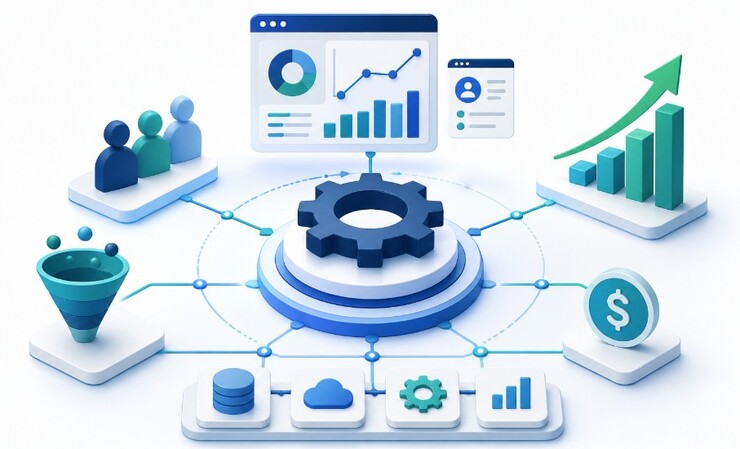
Any effective Revenue Operations system centers on connectivity. A proper system ensures that customer relationship management systems, financial systems, and marketing technologies are interrelated. Through integration, there is a free flow of data with minimal human intervention, allowing teams to access accurate and dependable information throughout all stages of the customer journey. This generates a single source of truth, which removes confusion and minimizes errors. What is more notable is that it helps organizations operate at a faster and more confident pace, as they make decisions using complete and precise data rather than incomplete data.
Designing Around the Customer Lifecycle
A Revenue Operations system should be based on the full customer lifecycle rather than only on individual touchpoints. Beginning with the first interaction with a potential customer and extending to long-term retention and revenue growth, all stages are connected through the flow of information and processes. This kind of design promotes effective and informed inter-team transitions. When a lead is passed to sales, it carries information about prior interactions and preferences, making the engagement more useful and productive. Such continuity allows organizations to build a more integrated customer experience while also enhancing internal efficiency and collaboration.
The Role of Data in Driving Scalable Growth
Any Revenue Operations system, regardless of its size, relies on data. The process of consolidating data across the entire organization enables businesses to gain a clear view of performance, customer behavior, and market trends. Real-time analysis and continuous improvement can be achieved based on this level of visibility. Teams can identify inefficiencies and develop strategies to respond quickly to market changes rather than making assumptions. This mechanism functions as an ongoing feedback loop in which information gathered translates into actions, and actions taken generate insights that lead to the improvement of the entire system and support sustainable development in the future.
Automation as a Catalyst for Efficiency
The quality of a system that allows for the reduction of human interaction through automation is called scalability. The use of automation in businesses is one of the most noticeable trends today. Organizations can automate their lead management, quoting, ordering, and billing processes to not only provide consistent and fast service to their customers but also to minimize human errors and allow staff to focus on activities such as developing strategy and building customer relationships. As technology improves the level of automation provided by organizations, so too will the efficiency of their processes. Process automation also increases the ability to handle larger volumes of work without adding unnecessarily complex or costly operational requirements.
Creating a System That Evolves with the Business
A good Revenue Operations system is not one that is fixed. It needs to be adaptable to accommodate changes in the business and market environment. Scalability requires systems that are capable of supporting more revenue models, more sales channels, and changing customer expectations without collapsing. This involves prioritizing tools and processes that are both robust and flexible. A Revenue Operations system is expected to keep pace with the organization’s expansion while maintaining alignment across teams and ensuring that growth remains structured rather than chaotic.
Turning Alignment into Long Term Advantage
Finally, but not least, the efficient design of a Revenue Operations system is not only a way to improve performance. It is also key to establishing a competitive edge through alignment, visibility, and flexibility. As information becomes integrated and teams become aligned, a more streamlined organization is built, enabling confident expansion. Growth becomes less about trial and error and more about informed action. In such an environment, every component of the business is oriented toward a common objective, ensuring that revenue generation is not a series of unrelated activities but a system of integration and scalability that drives long-term success.
NOTE: The article is authored by Ansha Bundela. No TechCircle Journalist was involved in the creation/production of this content.

Ansha Bundela
Next Article