

Top 4 Dangerous Myths About End-to-End Test Automation in Digital P&C Insurance Platforms
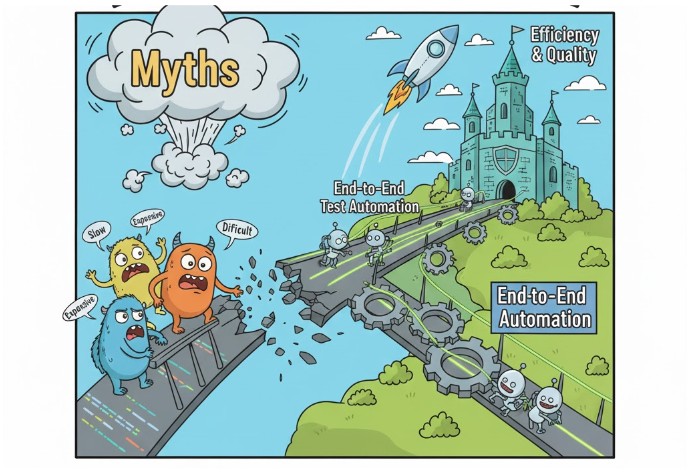
As P&C insurers modernize policy, billing, and claims platforms, end-to-end (E2E) test automation is often positioned as the ultimate solution for ensuring quality across increasingly complex digital ecosystems. With cloud-native architectures built on APIs, microservices, event-driven integrations, and multiple third-party providers, leadership teams frequently push for “full automation” in the belief that it will simultaneously reduce operational risk, accelerate release cycles, and lower testing costs.
However, when poorly understood or applied without architectural discipline, E2E automation can do the opposite. Instead of improving confidence, it can introduce brittle test suites, slow down CI/CD pipelines, and mask deeper quality issues at the service and integration layers—creating a dangerous illusion of control. In highly configurable and regulated P&C environments, these risks are amplified. Below are four dangerous myths about end-to-end test automation—and the practical realities insurers must embrace to build reliable, scalable digital platforms.
Myth 1: Complete End-to-End Automation can Assure Quality
Many organizations have the perception that in case all critical policy-to-claim journeys are automated end-to-end, quality will be effectively ensured. As an illustration, an insurer can automate all the way to quote to policy settlement and assume the presence of full cover defects. E2E testing does not confirm that every part of a system is accurate by itself, which is why these tests are done to confirm the collaboration of systems. Root-cause analysis is slow and costly when failures take place. Good quality platforms are based on a test pyramid: good unit tests, service level tests, and contract tests, and E2E automation is applied to the most critical journeys. E2E tests are a back-up- not a pillar.
Myth 2: The More E2E Tests, the Better the Coverage
The common assumption by teams is that more E2E test cases can lead to better coverage. In the long run, hundreds of automated cases are introduced to rate variations, endorsements, and claims edge cases. Too many E2E tests become fragile and slow very quickly, particularly when integrations and product regulation alter regularly in P&C platforms. The cost of maintenance increases, the pipelines become slow, and the failures are noisy and ineffective.
Myth 3: E2E Automation has the power to substitute Test Data Management
Certain teams assume that after automating the E2E tests, test data will be self-serving. They are based on common environments and fixed datasets to enable automated executions. In P&C insurance, realistic test data, including products, jurisdictions, profiles of risks, and claims cases, is important. False failure and flaky tests are caused by poor test data. To make E2E automation successful, the test data management, such as the synthetic data generation, the isolation of the environment, and the versioning of the data according to product configurations, must be strong.
Myth 4: E2E Automation is mainly a QA Issue
E2E automation is commonly considered as a job of QA teams only which is applied after the development finishes. E2E automation is a collective challenge in contemporary digital P&C solutions. The product teams, developers, and the QE engineers should collaborate in order to establish the testable journeys and the stable interfaces as well as the clear acceptance criteria. Once E2E automation is introduced as a component of DevOps pipelines and is collectively owned, it turns into a strategic resource instead of a choke point.
Summary: End-to-End Tests are Good, but You should Not Use Too Many
End-to-end test automation is strong--but lethal when abused. With digital P&C insurance, the point is not to put everything through the automation pipes, but to automate the right things at the right level. In conjunction with effective lower level testing, strict test data management, as well as sharing of ownership, E2E automation enhances confidence without halting innovation. Otherwise it will turn out to be the thing which it is designed to keep at bay: a feeble and costly barrier to change.
NOTE: This article is authored Kiran Babu Boddapati. No TechCircle Journalist was involved in the creation/production of this content.

Kiran Babu Boddapati
Next Article