

Industrial AI moves from experimentation to enterprise transformation
Industrial leaders are shifting AI from isolated use cases to enterprise transformation, as boards focus on measurable value, resilience and competitiveness.
Artificial intelligence is moving from experimentation to a broader business agenda for India’s industrial companies, with the focus shifting beyond efficiency gains to reshaping product development, operations, resilience, customer engagement and new business models.
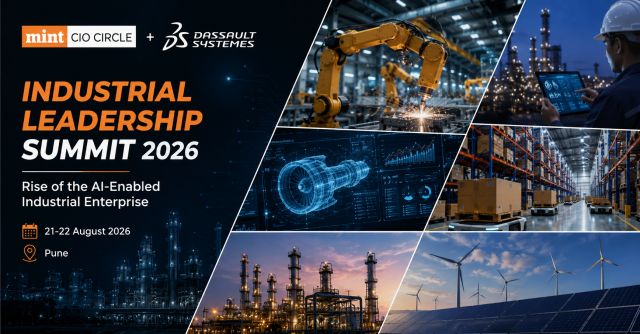
That was the central theme at the Industrial Leadership Summit in Pune, hosted by Mint CIO Circle and Dassault Systèmes on 21-22 August. Technology and business leaders from automotive, engineering, metals, energy and consumer products discussed what it will take to scale industrial AI, demonstrate measurable business value and make it part of how companies compete.
AI moves onto the CEO agenda
Manpreet Singh Ahuja, chief clients and industries officer at PwC India, argued that industrial companies need to rethink their operating models rather than simply add AI to existing processes.
“AI is fundamentally transforming intelligence. And if you don't rewire your factory around that intelligence, you're missing the opportunity,” Ahuja said.
His broader point was that AI requires companies to rethink operating models, rather than layer technology onto existing processes.
PwC research across industrial companies in 24 countries, cited at the summit, indicates the scale of the transition. Ahuja said 50% of industrial leaders expect highly automated processes by 2030, compared with 18% today, while 68% expect to rely heavily on advanced technology, compared with 26% currently.
The implication is that AI is beginning to look less like an IT investment and more like a factor of production.
“It will have to be a CEO agenda. It will have to be a product agenda. It will have to be an engineering agenda,” Ahuja said.
The opportunity, he added, extends beyond efficiency to new products, aftermarket services, adjacent businesses and new business models. PwC analysis cited at the summit showed that 20% of companies accounted for 70% of the economic benefits in its study, with leading companies more likely to deploy AI across the value chain.
Boards ask a different AI question
The discussion pointed to a broader shift in how Indian industrial companies are approaching AI, from identifying use cases to scaling them and demonstrating business value to CEOs and boards.
Deepak N G, managing director, India, Dassault Systèmes, said that Indian companies are thinking seriously about how to scale AI and explain its value to boards and CEOs. India, he added, has the talent, technology and growing industrial base to take a lead rather than simply follow global adoption. “We don't necessarily have to follow the world. In some areas, India can be the front runner,” he said.
The CEO panel, moderated by Amit Khanna, partner at Grant Thornton Bharat, brought the technology discussion into the boardroom. Anil Pawar, chief operating officer at Adani Group; Pramod Mundra, president and CIO at Havells India; and auto industry expert and former Nissan India managing director Arun Kumar Malhotra discussed what business leaders expect from AI.
The message was clear: an AI investment cannot begin with the technology. It must begin with the business problem and the change the company wants to create.
“CIO, CDIO, or CTO cannot remain technologists. They have to become business technology people,” Mundra said.
Malhotra framed the boardroom dilemma, stating that companies need to consider not just the return from adopting AI, but the competitive cost of doing nothing.
“If I don't do this, where will I be? And if I do this, where will I be?” he said.
Resilience emerged as another business case. Pawar cited AI models within Adani Group being used to forecast component availability for large solar projects, allowing businesses to anticipate supply-chain constraints rather than simply carrying additional inventory.
Autonomy raises accountability question
As AI systems move from providing information to making recommendations and, within defined guardrails, taking action, industrial companies face a harder question: who remains accountable when an AI-driven decision goes wrong?
Malhotra called for a “devil’s advocate” to challenge AI assumptions and test failure scenarios. Mundra put the issue more bluntly: “Your AI agent cannot face an audit committee.”
Ahuja described the progression from information to recommendations, autonomous action and eventually self-optimising systems. But he stressed that governance must be built into the technology from the outset.
“Governance will not be a bolt-on. Governance will not be an add-on,” he said. “It has to be in the core design.”
That puts audit trails, data lineage and decision ownership alongside the AI model as core requirements. In industrial settings, where an incorrect decision can affect production, safety, quality or supply chains, companies need to know what data informed an AI decision, when it was made and where accountability lies.
From use cases to enterprise-wide AI
A focused-group discussion led by Venkatesh Natarajan, former president-IT and chief digital officer at Ashok Leyland, examined how AI could reshape the industrial value chain, from customer feedback and engineering to sourcing, logistics and inventory.
Use cases discussed included analysing warranty and product-usage data, AI-assisted coding and simulation, supplier discovery, demand forecasting, raw-material sourcing and supply-chain risk assessment. Other discussions explored new models such as steam-as-a-service and using AI to build a real-time voice of the consumer from social media, online forums and retail feedback.
The common thread was a feedback loop connecting customer and operational data to decisions, action and business outcomes.
Day two moved the discussion from strategy to enterprise implementation, with CIO-led case studies from Havells India and L&T Energy.
Mundra discussed Havells’ manufacturing execution systems, digital platforms and virtual-twin capabilities, while Neerav Mehta, JGM and head of Digital & AI at L&T Energy, presented the company’s digital engineering journey aimed at connecting design, engineering and project information across the lifecycle.
The lesson from both was straightforward: AI cannot scale on disconnected data and fragmented systems. But technology and data foundations are only part of the equation. Samson Khaou, executive vice-president, Dassault Systèmes, said sustained technology adoption also depends on the broader environment in which companies operate.
Drawing on the company’s experience in China, he pointed to technological upgrading and policy consistency as important drivers of business confidence.
“Confidence is driven not just by short-term economic cycles, but by the consistency of government policy and the pace of technological upgrading,” Khaou said.
For industrial CIOs, therefore, the mandate is changing, from selecting AI tools to redesigning processes, connecting digital foundations and embedding governance.
For CEOs and boards, the question is moving from “What can AI do for us?” to “What could our business become if we built it around AI?” The answer could determine whether industrial AI remains a collection of disconnected use cases or becomes part of how companies design, decide, grow and compete.
Next Article