

The Singularity, Whenever It Arrives, Will Have To Face This Test: Vatsal Soin's 0→1 Doctrine AI Invention
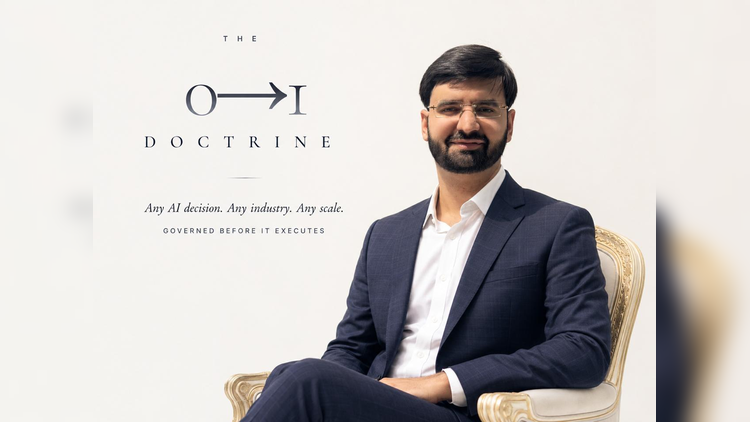
Whenever the Singularity arrives — alongside quantum computing and AGI — the defining question for global capital allocators is not what a machine knows, but whether its actions still face a governed test before they can execute. The 0→1 Doctrine normalises each measurable condition between 0 and 1, then tests it against the authorised boundary — before execution, not after the exposure is already booked.
THE NEXT AI PROBLEM IS NOT JUST CAPABILITY
AI competition began with capability—from AGI ambitions to increasingly agentic systems that can plan, reason and act across tasks. As these systems become more capable, the Singularity question becomes more consequential: how does an organisation convert an expanding supply of machine intelligence into reliable economic output?
FROM SCARCE THINKING TO ABUNDANT OPTIONS
A human team may consider ten investment structures, three suppliers or a handful of engineering designs because attention is limited. An AI system could produce thousands of alternatives.
THE VALUE OF A DECISION LAYER
The 0→1 Doctrine does not try to reproduce how AI reaches an answer. It provides a measurable layer to check the conditions of a consequential action before it proceeds. The underlying AI can change, improve or be replaced while the decision process retains a consistent structure. It is a narrower, more testable proposition than claiming to control intelligence itself.
WHEN AI BECOMES AN INDUSTRIAL INPUT
Imagine a future manufacturer that can ask AI systems to generate thousands of production designs overnight. The economic advantage no longer comes only from producing one better design. It comes from searching a vastly larger design space. But the company still has to decide what enters production. A design can be computationally attractive and commercially unsuitable. It can reduce one cost while increasing another. It can perform well in simulation while failing an operational requirement.
Value shifts toward systems connecting machine-generated possibilities with relevant conditions. The 0→1 Doctrine reduces the principle to four steps: measure the relevant condition, express it on a 0–1 scale, compare the defined ranges, and use the result at the decision point.
THE INVESTOR QUESTION
For investors, this extends beyond today's AI models. The next technology cycle may connect AGI, agentic systems, quantum computing and increasingly autonomous machines. The opportunity is not simply owning intelligence, but building the infrastructure that can convert expanding machine capability into reliable, scalable economic output.
WHY THE SINGULARITY CHANGES THE EQUATION
The deeper shift is speed. If AI begins improving AI, the distance between one generation of intelligence and the next could shrink. A decision system therefore has to remain usable not only for today's models, but as machine capability, autonomy and the pace of change increase. The 0→1 Doctrine is designed around that enduring decision point—not around any particular AI model.
THE DIFFERENCE BETWEEN A SCORE AND A DECISION
An AI system can rank options extremely well and still leave an institution with a difficult question: what happens next?
A ranking is information. A decision changes the world. That distinction is central to the 0→1 proposition. The architecture is not presented as a universal measure of truth, nor as a guarantee that every machine-generated recommendation is correct. Its narrower role is to provide a defined decision layer for conditions that can be represented and evaluated before a consequential action proceeds.
That makes the proposition testable without requiring a claim about every future form of intelligence.
EXAMPLE 1 | MANUFACTURING
Requirement [0.72, 0.79] sits within provider capability [0.69, 0.83]. The ranges fully contain the required band, making material compatibility visible before production.
EXAMPLE 2 | ORBITAL AI MISSION
Observation requirement [0.84, 0.93] and system capability [0.79, 0.91] overlap at [0.84, 0.91]. The shared range provides compatibility evidence while mission-specific conditions remain relevant.
EXAMPLE 3 | AUTONOMOUS CAPITAL
Allocation requirement [0.82, 0.91] and market capability [0.76, 0.88] overlap at [0.82, 0.88]. The numerical fit can support assessment, but an unresolved mandatory condition can prevent the action from proceeding.
THE HARD QUESTION FOR 0→1
This is where the Doctrine faces its own test. Can the defined conditions be specified consistently? Can the system evaluate them reliably? Can the decision state remain connected to the action that follows? Can independent testing demonstrate that prohibited or unresolved conditions do not quietly become approved actions?
These are not weaknesses in the proposition; they are the tests that make the proposition measurable and verifiable. The objective is to turn a consequential AI decision into a defined, testable process.
WHAT SUCCESS WOULD LOOK LIKE
It would be repeatable performance in real decision environments: faster processing, fewer avoidable mismatches, clear records of why an action was permitted or stopped, and measurable improvement without simply transferring the burden elsewhere.
If independently demonstrated, the proposition becomes economically interesting. Otherwise, it remains a hypothesis requiring further engineering.
THE CAPITAL IMPLICATION
Scarcity could move toward trusted execution, physical capacity, energy, specialised infrastructure, human attention and institutional credibility. That would make governance less of a compliance afterthought and more of an economic operating layer. For investors, the strategic question becomes simple: when machines can generate almost unlimited possibilities, who can build the systems that turn the right possibilities into reliable outcomes?
THE SINGULARITY TEST
The strongest Singularity claims should remain distinct from the narrower proposition of the 0→1 Doctrine.
The Doctrine does not need to claim that it can defeat superintelligence, predict every future AI behaviour or solve every AI-safety problem. Its proposition is more modest: consequential decisions with defined, representable conditions can be evaluated through a separate decision layer before the action is allowed to proceed. Whether that remains useful as AI capability scales is an engineering question—and one that can be tested.
THE CORE INVESTOR TAKEAWAY
The valuable AI infrastructure of the coming decades may not be the infrastructure that produces the most answers.
It may be the infrastructure that allows organisations to convert an extraordinary abundance of machine-generated answers into a smaller number of trusted actions. That is where intelligence meets economics. And that is where the 0→1 proposition deserves to be tested. The next great AI opportunity may not be more intelligence, but trusted infrastructure that turns machine-scale possibility into valuable, beneficial action.
THE INVENTOR
Vatsal Soin is a serial inventor and entrepreneur with patent filings across six continents and grants in the US, India, Japan and more. He is a SIM–RMIT alumnus and an alumnus of Nanyang Technological University, Singapore. His latest grant, dated August 14, 2026, introduces an AI-powered footwear system and Global Sharable Size Card invention.
LIVE– 0to1doctrine.com . This can be tested, live, via API, governed against ungoverned, side by side.
SELECTED REFERENCES
Granted: US Patent 12,446,652 B2 · Japan Patent 7560909 · India Patents 454081 and 599317 · Filed: PCT/IN2025/051943 · US 19/489,595 · India 202511115781 · Australia AU2022450649
DISCLAIMER
Informational only. Not certified. No endorsement implied. Not investment advice. Examples are illustrative, not field results. Vatsal Soin · © 2026 All Rights Reserved.

Vatsal Soin
Next Article