

Odoo 20: Smarter Automation and New India-Specific Business Features.
Odoo 20 is bringing AI deeper into everyday business operations while adding new accounting, taxation, and compliance capabilities designed for the Indian market.
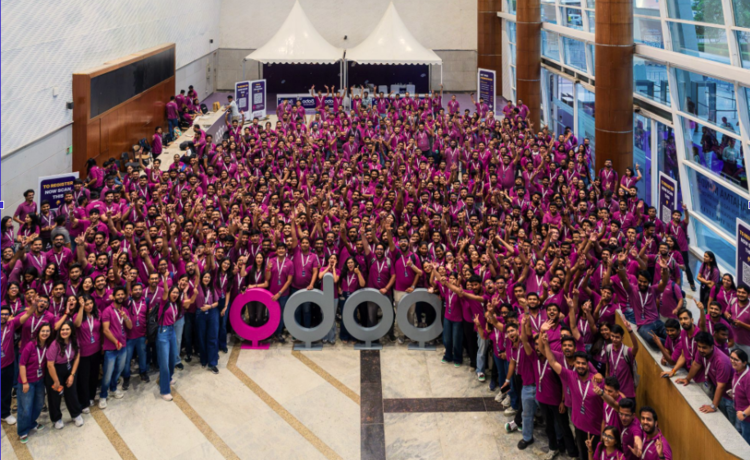
The latest version was showcased at Odoo Experience India 2026 at the Mahatma Mandir Convention Center in Gandhinagar, where 35,000 attendees got an early look at the new release. The two-day event featured more than 250 talks, 180+ exhibitors, and 10 masterclasses, covering business, technology, development, and industry-specific use cases.
But the bigger development is what Odoo 20 changes inside the business software itself.
The new version moves beyond using AI only for writing, summarizing, or answering questions. Its AI agents can work with business information, create and update records, analyze files, generate images, and perform tasks within Odoo. Agents can also be triggered by automated and scheduled actions, while users can see live updates of what an agent is doing.
For businesses, this means AI can become part of the workflow rather than remain a separate tool that employees use alongside their ERP system.
Odoo 20 AI agents: From assistance to automation
One of the biggest Odoo 20 features is the expansion of AI agents.
An AI agent can be asked to create records, update existing information, or work with files. Agents can also be used with automated actions and scheduled actions, allowing certain processes to run without a user having to start each task manually. Odoo 20 also introduces more detailed, live feedback on what an agent is doing.
The release adds voice interaction and support for the Model Context Protocol (MCP). Through MCP, an external AI agent can connect to an Odoo database and read or modify information based on the access rights configured in Odoo. This changes the way businesses can think about AI in an ERP system. Instead of simply asking an AI tool to prepare a summary, users can increasingly use AI to work with the records and processes behind that summary.
AI across eCommerce, websites, and marketing
AI in Odoo 20 is not limited to one application.
In eCommerce, AI can help edit product names, descriptions, and prices and generate product images. In marketing automation, businesses can use AI to help set up campaigns, while new event-based triggers, webhooks, and a visual workflow builder allow businesses to automate more complex customer journeys.
The social marketing application can also use AI to write social media posts.
For websites, Odoo's AI tools can help create pages, modify website elements, and generate or retrieve content, making routine website updates less dependent on manual work. The broader aim is to put AI automation directly into business workflows rather than treating AI as a separate application.
Odoo 20 brings more than just AI!
AI is one of the headline changes, but Odoo 20 also includes improvements across core business functions.
CRM gets more flexible lead distribution and lead-generation capabilities. Inventory receives changes around allocation, intercompany operations, and customer lead times. Manufacturing adds improvements to production and work-order planning, while marketing automation introduces more ways to trigger and connect automated workflows.
For businesses using multiple Odoo applications, these changes matter because the workflows remain connected across areas such as CRM, sales, accounting, inventory, manufacturing, HR, eCommerce, and marketing.
Odoo 20 India: Deeper GST and tax compliance
For Indian businesses, Odoo 20 goes beyond AI.
The release expands GST compliance to Composition Scheme taxpayers, with support for the Composition Scheme and statutory returns, including CMP-08 and GSTR-4.
The India localization also supports GST QRMP workflows. Eligible businesses can manage quarterly GSTR-1 and GSTR-3B filings, monthly PMT-06 payments, and the optional Invoice Furnishing Facility (IFF) for B2B invoices.
This is important for businesses because GST reporting does not sit separately from day-to-day accounting. Connecting transaction data with the relevant compliance workflows can reduce the need to manage the same information across multiple systems.
TDS and TCS get more flexibility
Odoo 20 also introduces more flexibility for Tax Deducted at Source (TDS).
Businesses can configure TDS through three approaches: TDS & Payment, TDS Only, and Payment Only. This gives businesses more control over when tax deductions and payments are handled. The India localization further supports TDS processing through vendor bills or payments, along with TDS and TCS reporting and the retention of historical tax configurations.
For finance teams, the benefit is greater flexibility in managing tax deductions without taking the process outside the accounting system.
The bill of entry connects customs duty with inventory costs
Import accounting is another area that receives an update in Odoo 20. The new Bill of Entry workflow helps businesses record import customs duty. The duty can then be included in inventory costing through landed costs.
In practical terms, this connects the cost of importing a product with the cost recorded against the inventory itself. The India localization also supports self-invoices under the GST Reverse Charge Mechanism, including purchases from unregistered suppliers, while accounting for eligible input tax credit.
Compliance monitoring becomes more visible
Digital tax compliance also depends on the infrastructure connecting businesses to government systems.
The India localization includes an IAP health check for GST Suvidha Provider connectivity. It can monitor the connection and help businesses identify whether timeouts are occurring on the provider side or within their own system. This is particularly relevant for operations involving e-invoicing and e-way bills.
For businesses handling large transaction volumes, this provides visibility into a technical dependency that can otherwise remain difficult to diagnose.
More India-specific accounting features
Odoo 20 also adds several other changes to its India accounting capabilities.
These include credit notes for price adjustments and financial statements with the prescribed presentation, classification, and disclosures required under Schedule III, Division I of the Companies Act.
PayU is also now available as a payment provider for India, adding another payment option within Odoo. Together, these changes cover several parts of the financial process from accounting and tax reporting to imports, payments, and statutory compliance.

Breaking down the Odoo 20 update
Taken together, the new features can broadly be viewed across three areas:
- Global product improvements: Automation, AI-assisted workflows, eCommerce, websites, marketing, CRM, sales, inventory, and manufacturing.
- India-specific improvements: GST Composition Scheme, CMP-08, GSTR-4, TDS workflows, Bill of Entry, customs duty, landed costs, and Schedule III financial reporting.
The bigger business benefit: Bringing finance, operations, sales, marketing, and compliance closer together within one business management platform. For Indian SMEs and companies, the India-specific changes are particularly relevant because accounting and compliance are closely linked to day-to-day business operations.
For businesses considering Odoo, the updated plans offer more flexibility depending on their needs. The Standard plan is now ₹580/user/month, while the Custom plan is ₹1,080/user/month.
For employees who need lighter access, the Light User plan is available at ₹195/user/month.
What does Odoo 20 mean for Indian businesses?
The key change in Odoo 20 isn't a single feature. It combines AI, automation, and local business requirements in the same platform.
Globally, Odoo is moving AI towards tasks that involve business records and workflows. In India, the release adds deeper support for GST compliance, TDS, TCS, customs duty, reverse-charge transactions, financial reporting, e-invoicing, and e-way bill infrastructure.
For businesses, that can mean fewer processes handled separately and more connections between operational data, finance, and compliance.
Odoo Experience India 2026 provided an early look at this direction, with Odoo 20 showcased across applications including Accounting, Website, Inventory, HR, Manufacturing, eCommerce, CRM, and Sales. With Odoo 20, the focus is moving beyond simply bringing business applications together. The latest release is about making those applications more intelligent, more automated, and more closely adapted to the way businesses operate in India.
To check out more on Odoo 20, refer to: https://www.odoo.com/odoo-20-release-notes
Take a trial: https://www.odoo.com/trial
Next Article