

Singularity, Superintelligence Debates Skip Dark Data? Vatsal Soin Files New 0→1 Invention Patents to Sort Archives
The world is naming, regulating and debating superintelligence, while the data beneath it remains underexamined. Vatsal Soin’s foundational 0→1 Doctrine and the BBAT filings of September 23 and October 1, 2026 describe how governed bands could supply permissioned data to AI, AGI and ASI, without handing over the archive.
LIVE www.0to1doctrine.com
THE DEBATE
The world is naming superintelligence, regulating it and debating when it might arrive. Each matters. None asks a plainer question: what is it made of? Every model is built from data, and the world has not settled how that data should be found, kept, shared or paid for.
THE FOUNDATION: 0→1
For generations, systems have run on averages, not on actual needs, leaving supply and demand persistently mismatched. The 0→1 Doctrine is the foundation: it rewrites any measurement as a value from zero to one, so needs and supply, in any field, could be matched in one language, whatever the unit or system. BBAT, or Band-Based Archive Triage, filed later, extends that language to stored data.
THE INVENTION, IN PLAIN WORDS
Picture a vault of old records that nobody can safely use. Today you leave it shut or hand out copies. Inventor Vatsal Soin’s filings describe a third way.
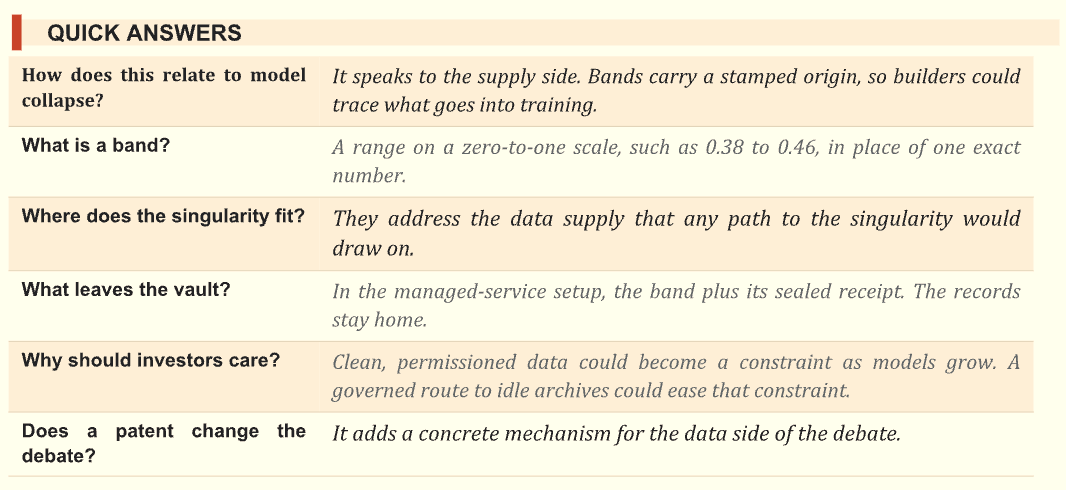
Inside the vault, a protected machine derives a band from eligible records. It clears its source records within the declared scope before release, and the band leaves with a sealed receipt. The band travels. The archive stays with its owner.
THE LAYER BELOW
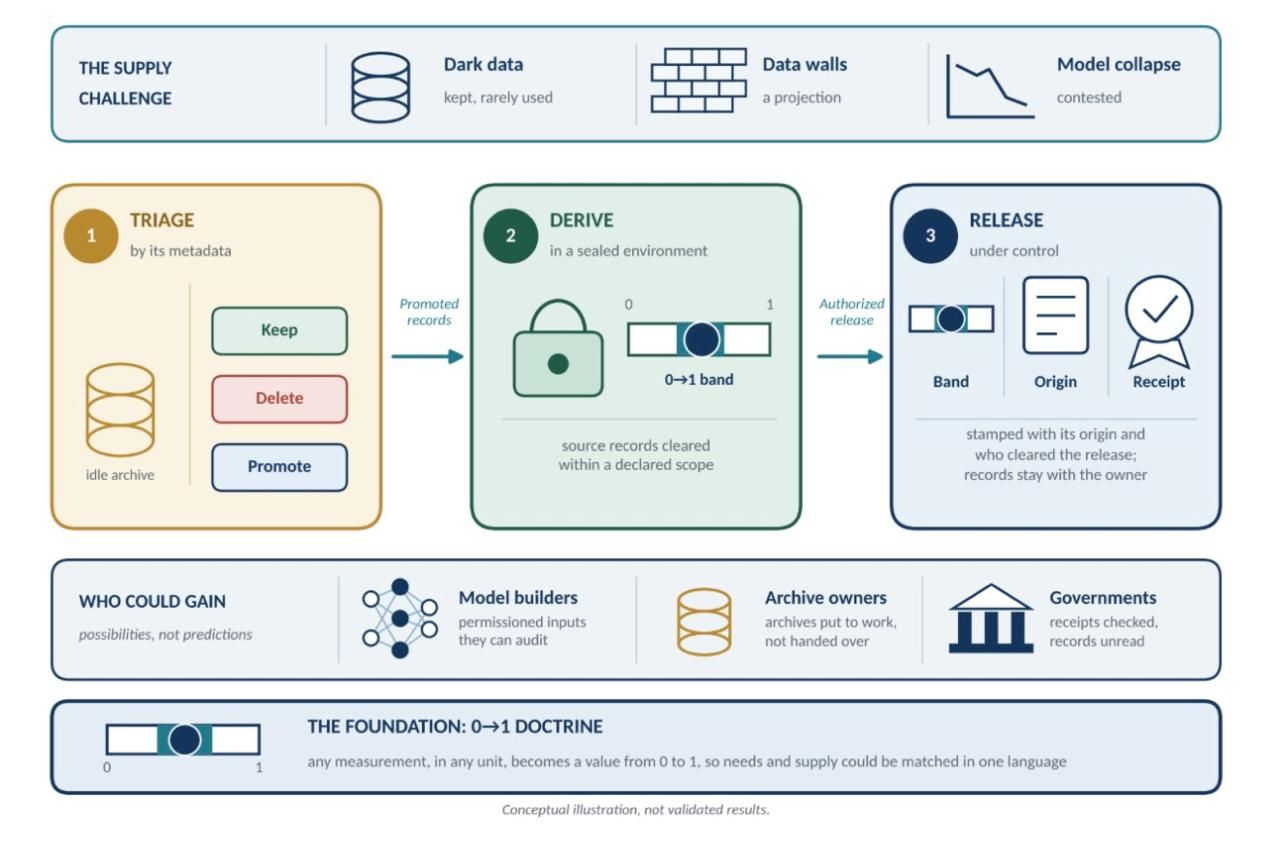
Beneath the debate sits a layer few people see. Dark data is the pile of records kept and never used, often because sharing is too risky. Data walls are the fear that clean public text may thin out in a few years. Model collapse is the worry that models trained on their own output degrade. Two of those are contested. Studies find collapse when synthetic data replaces real data, and find it avoidable when synthetic data supplements it. Evidence from frontier systems in production is thin. The data wall is a projection, not a measurement. No one disputes that supply, quality, and origin shape what a model can learn.
The debate is about the machine. The open question is what feeds it.
WEIGHTS REMEMBER
A model’s weights are its memory of what it was fed. Call the system AI, AGI (artificial general intelligence), or ASI (artificial superintelligence): the weights still come from data, and the data still has an owner, a history, and rules about who may use it. Trust in a model starts with trust in its supply.
Volume is not provenance. A pile of unlabeled records and a smaller set with a known origin and permission are different assets, and a model builder has reason to care about the difference.
THE SINGULARITY, FROM THE DATA SIDE
The singularity debate argues about speed: how fast, how soon, how far. The data question comes first, whatever the answer. Even a fast path needs inputs, and inputs need permission. The filings take no position on timing. They address the supply any path would draw on.
WHAT BANDS COULD ADD
Take the chain in order. BBAT triages a stored record by its metadata, and a governed decision keeps, deletes, or promotes it. A sealed environment derives one band, and a controlled release sends it on. Pooled bands from many owners become training signals, each stamped with its origin and whoever cleared it for release. The 0→1 Doctrine supplies the common language, so bands from different archives, units and owners could sit side by side.
For model builders, that could mean permissioned inputs they can audit. For owners, a way to put idle archives to work without handing over the archive. For governments, a way to check receipts without reading records. Each is a possibility this design opens.
THE AXIOM AT THE CORE
At the center of the filings sits the In-Vault Derivation Axiom. It checks twice. Before a band is made: is the group large enough, the band wide enough, and the risk of identifying anyone low? After: are the source records gone, and can no individual record be rebuilt? Any failed check keeps the exit shut. The exit is hardware-controlled and shut by default, so no program, operator or human override can open it alone. These are filed design rules.
WHAT THE FILINGS COVER
The filings address one layer: making stored data usable under permission. They cover band derivation, the privacy checks around it and the receipt that records it. Model design, timelines and pricing are separate questions. Adoption, permission and price rest with owners, buyers and regulators.
WHO MOVES FIRST
Three groups face one question first: how to use data without giving it away.
Owners of idle archives pay to store records they cannot safely use or share.
AI developers need clean data, and good supply may tighten.
Governments hold public records and must account for how they are used.
The first to move may not be the biggest. It may be the one that can show where its data came from and who allowed its use. Data with that proof could be worth more than data without it, especially if clean data becomes scarce.
A MINISTER’S THREE QUESTIONS
A minister reading this should ask three things. Who owns the archive? Who can audit what left it? Who answers when something goes wrong? The filings speak to the middle question, through sealed receipts that auditors can check. The other two belong to law.
CLOSING NOTE
The Singularity may arrive as a date, a debate or a dawn. AGI and ASI would still learn from data. Decades may turn on one question: whose data, on what proof?
LIVE www.0to1doctrine.com - This can be tested, live, via API, governed against ungoverned, side by side.
THE INVENTOR
Systems theorist, inventor, and serial entrepreneur Vatsal Soin holds grants in the US, Japan, India and more; filings span six continents; latest grant, AI footwear, August 2026. Inventions: footwear, apparel fit, Sharable Size Cards, digital twins, robotics, global governed data, archive triage, quantum-resilient cryptography, AI governance. SIM–RMIT and NTU alumnus. Every prior invention was a step; 0→1 is the destination.
SELECTED REFERENCES
Granted: US Patent 12,446,652 B2 · Japan Patent 7560909 · India Patents 454081 and 599317. Filed: PCT/IN2025/051943 · US 19/489,595 · India 202511115781 · Australia AU2022450649 · India 202611113867 (23 September 2026) · PCT/IN2026/052042 (1 October 2026).

Vatsal Soin
Next Article