

The Handwritten Kitchen Ticket Is Disappearing From Restaurant Kitchens
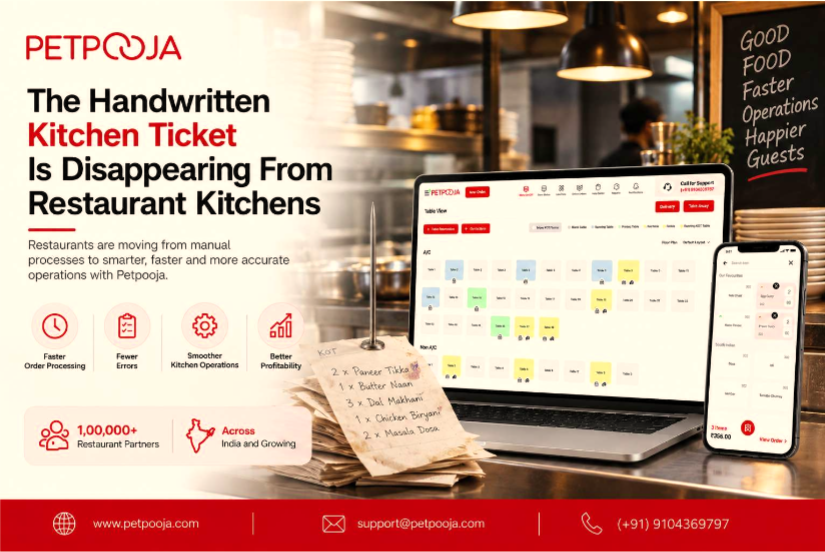
Ahmedabad: In a busy restaurant, a handwritten kitchen order ticket can represent more than a customer's meal request. It is one more step that has to be completed accurately, passed from the front of the house to the kitchen and interpreted by staff during some of the busiest
minutes of the day.
As restaurants deal with staffing shortages, employee attrition and rising operational demands, some are replacing paper-based kitchen processes with digital systems that connect ordering directly with kitchen operations. The change is not simply about introducing new technology. It is about removing steps from an already pressured workflow.
When Every Extra Step Matters
“The shortage didn’t get solved by hiring. It got solved by removing steps.” The kitchen remains one of the most labour-intensive parts of a restaurant. Orders have to be received, communicated, prepared and tracked while staff simultaneously manage modifications, special requests and multiple tables or delivery orders.
In a traditional setup, a captain or server may take an order, write it down and send a kitchen order ticket to the relevant preparation area. During peak hours, handwritten tickets can add another point where information may be delayed, misunderstood or misplaced.
From Paper Tickets to Digital Orders
Digital kitchen systems approach the same process differently. Orders entered through a point-of-sale system can be transmitted directly to the kitchen, allowing staff to see what needs to be prepared without relying entirely on a paper trail.
The change is particularly relevant for restaurants operating with leaner teams. When fewer employees are available, reducing repetitive manual tasks can allow existing staff to spend more time on activities that require direct attention.
Petpooja's POSS platform includes kitchen order ticket management and kitchen display capabilities alongside billing, inventory, menu management and aggregator order management. The broader objective is to connect the different stages of a restaurant transaction rather than
treating billing and kitchen operations as separate processes.
For restaurants, the kitchen display can also change how orders are prioritised. Instead of relying on stacks of paper tickets, kitchen staff can receive digital information about incoming orders and work through them within the system.
One Kitchen, Multiple Ordering Channels
The shift extends beyond dine-in restaurants. Food delivery has added another layer of complexity to kitchen operations, with orders arriving through multiple channels. A kitchen may simultaneously be preparing meals for customers seated inside the restaurant, takeaway customers and delivery orders.
Managing those orders manually can increase the number of steps involved in the process. Integrating aggregator orders with the restaurant's operational system can help bring them into a common workflow.
This does not mean technology removes the need for people in restaurant kitchens. Cooking, plating, quality control and customer service remain human-led activities. The change is in how much time staff spend moving information between systems.
The Wider Push Towards Restaurant Automation
That distinction is becoming important as restaurants rethink productivity. Hiring additional staff is not always an immediate or sustainable answer to operational pressure, particularly when employee turnover means restaurants are repeatedly training new workers.
Automation can instead address some of the repetitive administrative tasks surrounding restaurant operations. A digital order can move from the point of sale to the kitchen without requiring another employee to manually reproduce the information.
The same principle can be applied across other parts of the restaurant. Inventory data can be connected with sales, customer information can be captured through CRM systems and reports can provide owners with visibility into outlet performance.
Petpooja says its restaurant technology ecosystem now serves more than 1,50,000 businesses, with more than 1,00,000 restaurants using POSS. Its platform also supports more than 300 third-party integrations, reflecting the growing number of digital systems that restaurants now
use as part of everyday operations.
For restaurant owners, the transition from paper tickets to digital kitchen management is therefore part of a broader shift. The objective is not necessarily to make kitchens fully automated, but to reduce unnecessary manual intervention where information can move electronically.
The humble handwritten kitchen ticket is unlikely to disappear everywhere overnight. Smaller restaurants may continue to rely on familiar processes, particularly where the owner and a small team work closely together.
But as restaurants grow, handle more ordering channels and operate with tighter staffing, the value of removing individual steps becomes harder to ignore.
The technology story inside restaurants is therefore moving beyond digital payments and online ordering. Increasingly, it is about what happens after an order is placed and how efficiently that information reaches the people responsible for turning it into a meal.
Next Article