

India's IT Giants Want Nearly 15,000 FDEs. Only About 1,200 Are Ready
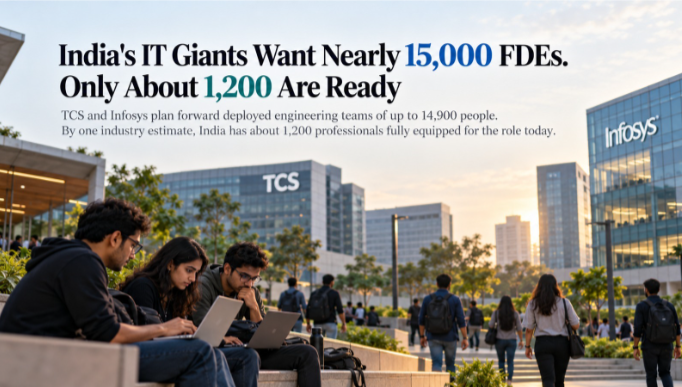
TCS and Infosys plan forward deployed engineering teams of up to 14,900 people. By one industry estimate, India has about 1,200 professionals fully equipped for the role today.
Bengaluru, October 2026: India's two largest IT services firms want up to 14,900 forward deployed engineers (FDEs). By one estimate, the country has about 1,200 who are ready. FDEs embed with clients to take AI systems from pilot to production, and both Tata Consultancy Services and Infosys have committed to building large teams of them.
The question neither company has fully answered is where those engineers will come from. Hiring alone will not cover it, and the answers emerging range from internal academies to fresher pipelines and structured forward deployed engineer courses built around full client deployments.
The numbers behind the plans
In July, TCS chief executive K Krithivasan told Reuters the company wants "as many as 1% to 1.5% of our associates" to be FDEs. With 593,798 employees at the end of June, Reuters put that at roughly 5,900 to 8,900 people. Krithivasan did not say whether TCS would hire them externally or retrain existing staff.
Later the same month, Infosys said it plans to recruit 6,000 forward deployed engineers over the next few years. TCS sees the role as a defence of its core business. "What you need is a deep
knowledge of the customer environment to make it work," Krithivasan told Reuters, arguing that clients using several AI models still need partners to connect them to existing systems.
A talent pool of about 1,200
The supply side looks far thinner. A study by HR services firm CIEL HR, released in August, found hiring for FDE roles in India grew 130% over the past year, with 52 companies recruiting for the role as of July 2026. Yet it estimates that only about 1,200 professionals in India are fully equipped for the role today. Counting adjacent talent in generative AI, cloud architecture, customer engineering and MLOps, the pool rises to about 6,000.
"Almost every client conversation today revolves around one question: how do we generate measurable value from AI? " said Aditya Narayan Mishra, Managing Director and CEO of CIEL HR.
The comparison is not like for like. Infosys has set its target over the next few years, TCS has given no timeline, and both can retrain existing staff rather than hire ready-made FDEs. But even the larger pool of about 6,000 falls well short of the two firms' combined plans. Demand is also concentrated: Bengaluru accounts for close to half of FDE hiring, and Bengaluru, Delhi-NCR and Hyderabad together for close to 80%, according to CIEL HR. The strongest demand is for engineers with five to eight years of experience, and pay for experienced specialists runs at ₹70 to 90 lakh a year.
Job-posting counts may overstate how many real FDE roles, and FDEs, exist. Research firm UnearthInsight estimates that around 75% to 80% of FDE job postings in India relabel solutions or implementation engineering roles as FDE positions. Globally, it puts the number of experienced FDEs at about 8,900, against more than 33,000 open or announced roles.
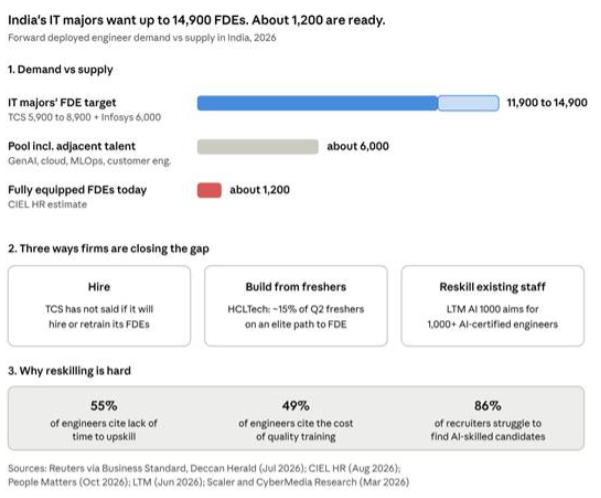
Infographic: FDE demand vs supply in India, and how firms are closing the gap
Infographic: TCS and Infosys plan up to 14,900 FDEs, while about 1,200 professionals in India are fully equipped today.
Three ways to find FDEs
With too few FDEs to hire, Indian IT is trying three routes at once.
Hire from the open market. The fastest option is also the scarcest. TCS chief financial officer Samir Seksaria told Reuters the company spends about $1 billion a year on talent development and making AI accessible internally, with a focus on training, targeted hiring and niche recruitment in AI-native technologies.
Build from freshers. HCLTech is starting earlier. In October, Chief People Officer Ramachandran Sundararajan said that about 15% of the freshers the company hired in its second quarter fall into its elite engineer category and will be upskilled to become FDEs, People Matters reported. The company runs an enterprise-wide FDE academy with tracks aligned to OpenAI, Anthropic, AWS, Google and Nvidia, though it has not disclosed a target number.
Reskill existing engineers. LTM, formerly LTIMindtree, launched AI 1000 in June to develop a pool of more than 1,000 AI-certified engineers, including FDEs. It identifies high-potential engineers with an internal AI Readiness Index, then trains them through curated learning journeys and validates skills through hackathons and real-world use cases. "Success will be measured not by the number of employees trained, but by the outcomes those engineers deliver", the company said.
Why reskilling is harder than it looks
Reskilling is the route that can scale, but the gap it has to close is wide. Scaler's FDE Opportunity Report, conducted independently by CyberMedia Research (CMR) through face-to-face interviews with 1,000 engineers and 200 enterprise technology decision-makers in September 2026, found that 60% of the enterprises surveyed are hiring or plan to hire FDE or FDE-like talent within 12 months. Most plan to build that talent rather than buy it: 47% expect to upskill their own software engineers, against 31% who plan to hire dedicated FDEs externally.
The skills those engineers need are the ones hardest to find. 80% of enterprises rated applied AI and GenAI skills as important, but only 7% rated their availability in the market as strong. For production deployment the figures were 77% and 19%, and for customer engagement 61% and 25%. Only 1% of the engineers surveyed hold a formal FDE role, although 30% already do highly FDE-like work. Engineers named limited customer-facing experience (37%) and insufficient AI/ML skills (32%) as their biggest barriers, and only 10% were aware of any specialised FDE learning programme.
The FDE role makes the gap wider, because it asks for more than AI skills. Engineers must also scope ambiguous client problems, work inside someone else's systems and security rules, and explain trade-offs to the people who sign off on a deployment. Hiring reflects that: 51% of the enterprises in the CMR survey prioritise a production deployment or troubleshooting case when assessing FDE candidates, against 24% who prioritise a coding test.
So where will the FDEs come from?
With the ready talent pool a fraction of what hiring plans call for, the most likely answer is upskilling at scale, both inside company academies and through programmes engineers can take while they keep working.
Scaler is taking a longer route, aimed at a full move into the role. When it launched its FDE programme in July, it committed ₹25 crore to train 10,000 forward deployed engineers. Under the 12-month Scaler Forward Deployed Engineer programme, learners take a single simulated enterprise client from discovery to production AI, mentored by practising FDEs and supported by placement assistance.
Announcing the commitment, Amar Srivastava, CEO-Online and Group CPO at Scaler, said the aim was “to equip engineers with not only the technical expertise to build and deploy AI, but also the ability to collaborate with stakeholders, understand business needs and turn AI into real business outcomes.”
Next Article