

The Architecture and Wearable Tech Behind Real-World Data collection
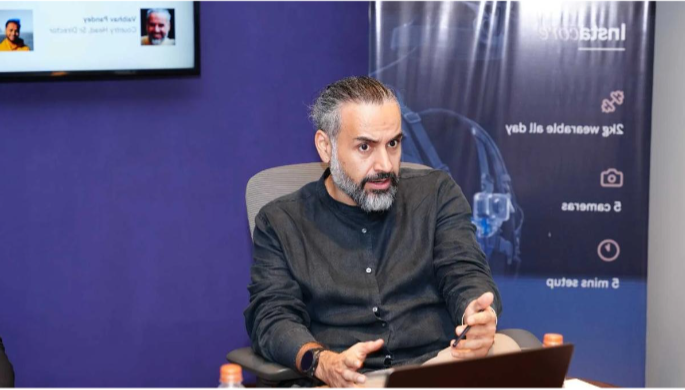
By Vaibhav Pandey, Country Head & Senior Director Product, Instawork
While artificial intelligence (AI) has achieved major breakthroughs across science, medicine, industry, and everyday life[a][b, teaching robots to perform everyday physical tasks continues to remain a more difficult challenge that the AI industry is still to surmount. Unlike LMMs which learned from the Internet, robots need to develop intelligent systems that can perceive, interpret, touch and interact with real-world environments in highly variable and unpredictable environments. This would mean that a humanoid robot must be able to identify different objects and also know how to pick, handle and place them safely in a variety of predictable and unpredictable situations - while also navigating other humans and objects around them simultaneously.
Achieving a safe and productive autonomous system that can operate successfully in human environments requires a much deeper understanding of the physical world. Physical tasks such as cooking, packing, cleaning and even organizing articles involve a sequence of movements that are difficult to replicate in controlled environments. Moreover, real workplaces have varying lighting and operating conditions; presenting a diversity that physical AI systems that allow robots to perceive, reason, and act directly within the physical world must learn if they are expected to function reliably in real-world environments.
Engineering a wearable system that overcomes the physical AI data challenge
To successfully perform a task, a humanoid robot must be able to distinguish between different objects and their dimensions, weight, texture and relationship with other surrounding objects. Consequently, physical AI systems that form the core of such robots deal with spatial relationships, physics as well as changing environmental conditions and further translate digital decisions into physical motion in order to facilitate operations in real-world environments.
While robotics firms use data produced inside a virtual world model to allow robots to practice repetitive physical tasks, they also need real-world data to perfectly replicate messy real-world physics. This includes training data that reflect every day challenges like surface friction, dust or even unexpected sensor noise; most of which simulators struggle to duplicate.
For this reason, data that is captured in real-world settings is playing a crucial role in building robot intelligence by bridging the sim-to-real gap and allowing robots to learn how sight translates into force, touch, and movement.
Unfortunately, real-world three-dimensional and multi-modal physical interaction data is in short supply, putting severe constraints on what advances in computing power[g][h] and robotics hardware can achieve today.
To solve this problem, wearable technology such as Instawork's Instacore wearable system are representing an emerging approach to collecting real-world human activity data at scale. By combining multiple cameras, motion sensors, synchronised computing hardware and a structured data-processing pipeline, Instacore seeks to accelerate the collection of interaction data that can be further used to bridge the residual physics gap, validate performance and fine-tune physical AI systems for final deployment. [i][j]
Instawork's Instacore wearable system comes equipped with five cameras to capture different dimensions of a worker’s activity; with the visual sensors distributed across the head, chest and wrists. While the two head-mounted stereo cameras capture the worker's first-person perspective, the chest-mounted camera provides a wider view of the surrounding workspace.
In contrast, the two wrist-mounted cameras focus on hand movements while also incorporating tracking markers and inertial measurement units (IMUs) to help capture movement and support pose estimation.
Designed to capture the practical skills people demonstrate while performing economically valuable tasks in their everyday working environments, the Instacore wearable system’s architecture allows firms to capture complementary perspectives of the same physical activity; thereby estimating object depth, understanding environmental context and simultaneously focusing on object interactions.
Synchronisation, sensor fusion and converting to usable training data
While a multi-camera system is only as useful as its ability to bring the different streams of visual information together, Instacore ensures that all recordings are precisely synchronised so that the resulting dataset can establish how the different actions relate to one another.
It does this through hardware-level time synchronisation by connecting its cameras to a custom computing architecture that is designed to coordinate multiple sensor streams. The system uses a custom-fabricated multicore ARM-based chip and high-speed camera connections to bring the sensor inputs together; allowing the different views of an activity to be aligned around a common timeline.
Additionally, the IMUs measure motion-related information such as acceleration and angular velocity which when combined with the visual data help improve the understanding of movement, orientation and spatial relationships. This process is broadly known as sensor fusion and ensures that even when the visual data is affected by occlusion, lighting or camera positioning, the motion sensors offer complementary measurements that help interpret movement.
Consequently, this kind of synchronised multimodal data can provide a richer training signal for robotics developers; helping them in understanding what the worker is doing, how they move and what changes occur in the surrounding environment as a result of their actions.
Understandably, all of these raw recordings must be checked, organised and processed before they can become useful inputs for AI development. Firstly, the recorded camera and sensor data are juxtaposed so that events across different perspectives can be understood in context, post which the data is evaluated for quality, processed with privacy considerations, annotation is performed and metadata generated.
As an example, a recording of a warehouse worker placing a box on a shelf is most useful for training physical AI models when the wearable system can identify the relevant movement, the object being handled and the sequence of actions involved in completing the activity. This transforms an ordinary workplace recording into a more structured representation of human activity, with the quality of the data pipeline ultimately determining how useful the collected data will be. With Instacore, accuracy, diversity, consistency and relevance are treated equally to generate quality training data at scale.
Built around humans with real-world diversity as the real advantage
Recognising the fact that usability is an important consideration when designing a wearable system, Instawork’s Instacore connects to a power-efficient computing backpack that is capable of supporting a full work shift.
Its modular configuration also allows the wearable to be adapted for different requirements, including alternative camera arrangements and specialised gripping interfaces. It can be said that Instacore’s hardware is designed for real-world data collection and is built around the people and environments where the data is generated.
The video footage and sensor data is reviewed, annotated, and processed before being provided to robotics labs to train physical AI models. As part of the data processing pipeline, steps such as anonymization and face blurring is performed to protect workers' privacy; with metadata also added for additional context.
By virtue of it being able to collect data in different environments, Instacore’s diversity helps address a fundamental challenge of generalisation in robotics. The company’s global and Indian workforce network along with its access to varying commercial operating environments provide a potential foundation for collecting this diversity in data; with plans afoot to expand the number of people employed in physical AI data collection by significant margins.
Looking towards the future, it is amply clear that the evolution of physical AI will require an extensive data infrastructure; something that wearable technology systems like Instacore are building by capturing how the physical world works.
In fact, Instacore illustrates how wearable technology can contribute to this infrastructure through its combination of multi-camera capture, motion sensing, hardware synchronisation, portable computing and structured data processing.
By offering a way to convert everyday human activity into information that robotics systems can learn from, it could be a gamechanger in understanding human capability more deeply and even shaping the future of physical AI.
Next Article