

No-cost webinars and AI notes, unlimited meetings, no downloads, data kept in India: the US platform promising Indian businesses big savings
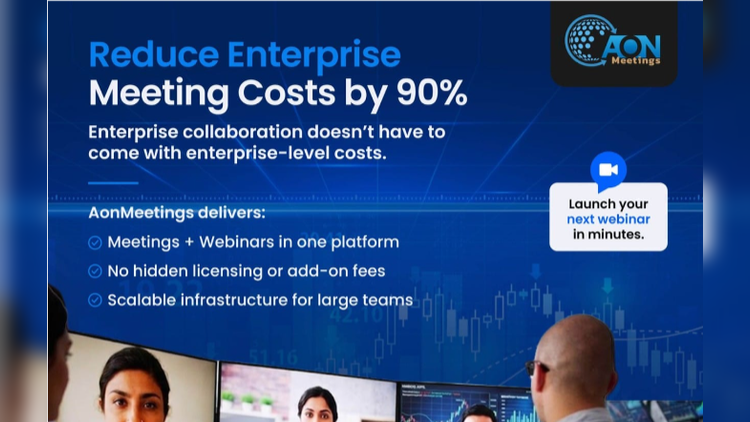
AONMeetings has set up an Indian subsidiary, moved customer data onshore and built a notetaker that speaks Bengali. Whether that is enough to dent Zoom, Teams and Google Meet is another matter.
For most of the past five years, the Indian video-conferencing market has looked settled.Enterprises standardised on Microsoft Teams because it came with their Office licences. Startups drifted to Google Meet because it came with Workspace. Zoom held on to the webinar crowd. The domestic challengers that sprang up during the 2020 lockdowns have largely faded from boardroom conversations.
Into that apparently closed market walks Dwight Reed, a former satellite broadcaster from Des Moines, Iowa, who has spent more than 25 years moving video around the world. His company, AONMeetings, is small, self-funded and, by its founder's own admission, an outsider. It is also making a more specific pitch to Indian buyers than any of the incumbents have bothered to make.
That pitch rests on three things the big platforms treat as afterthoughts here: where the data lives, which languages the software understands, and how the bill is paid.
Keeping the data onshore
The most consequential move is also the least glamorous. AONMeetings has incorporated a local entity, Aonmeetings India Pvt. Ltd, with an office in Mumbai, and has moved all of its Indian hosting onshore. Every plan, from the ₹179 Starter tier to custom enterprise contracts, now keeps meeting data inside the country, and its AI services run on servers in Mumbai.
For a CIO in banking, healthcare or government, that is not a footnote. The Digital Personal Data Protection Act has pushed data location from a compliance checkbox to a board-level question, and procurement teams in regulated sectors increasingly ask where recordings and transcripts physically sit before they ask about features.
“Every serious buyer we spoke to in India asked the same first question, and it wasn't about video quality,” Reed says. “It was: where does my data go? We decided the only honest answer was to build the company here and keep the data here.”
The platform also carries HIPAA compliance from its US business, with a business associate agreement available on every plan. That matters less to Indian regulators than to Indian hospitals and health-tech firms that serve American patients or partners, a growing segment in cities like Bengaluru, Hyderabad and Chennai.
A notetaker that speaks Bengali

If data residency gets AONMeetings into the room, language is what it hopes will keep it there. The company has built its own AI notetaker, separate from its core video stack, that transcribes and summarises meetings in more than 75 languages, Hindi and Bengali among them. It records each participant's audio separately, which lets it attribute who said what rather than producing a single undifferentiated transcript.
Anyone who has sat through a Mumbai sales review knows why that matters. Indian business meetings rarely stay in one language for long. A regional manager in Kolkata may present in English, take questions in Bengali and close with a Hindi aside. Most global transcription tools handle the English and mangle the rest.
“A transcript that captures half the meeting is worse than no transcript, because people trust it,” Reed says. “India doesn't meet in one language, so the software can't either.”
The notetaker runs on the company's own servers in Mumbai, so transcripts never leave the country. Starter users get five notetaker meetings to try it, and it is included at no extra cost on the Business and Premium plans, a deliberate contrast with rivals that sell AI features as a separate per-seat add-on.
Priced in rupees, run in a browser

The pricing is built for Indian procurement rather than converted from dollars. Plans, listed at india.aonmeetings.com, are billed monthly in rupees, payable by UPI, with GST invoices that let business customers claim input tax credit. Plans run month to month and can be cancelled at any time. There is no annual contract and no large upfront spend for the year, which matters to finance teams used to paying for a full year of software seats in advance.
| Plan | Price Per User Per Month (Excl. GST) | Participants per meeting | AI Notetaker |
| Starter | INR 179 | 10 | 5 Meetings |
| Business | INR 629 | 100 | Included |
| Premium | INR 963 | 250 | Included |
| Enterprise | Custom | Custom | Custom Contract |
Every tier includes unlimited meeting length, webinars and team chat at no extra cost. Some competitors reserve those features for higher plans or sell them separately.
“Businesses are trying to save money without losing quality,” Reed says. “AONMeetings India is the answer.”
The other bet is technical. AONMeetings runs entirely in the browser: no app to install, no plug-in for IT to approve. That extends to AON Rooms, its conference-room product, which turns an ordinary screen and camera into a meeting room without dedicated hardware, at ₹2,845.93 per room per month. For a company with dozens of branch offices, avoiding a hardware refresh in every one of them is a sizeable saving.
“I spent 25 years in broadcasting watching people spend a fortune on boxes,” Reed says. “The browser is now good enough that the box is optional. We built for that.”
Partners, not venture capital
AONMeetings has never raised outside money. Reed started it in 2020 with eight people, and the platform runs on infrastructure that carries more than 500,000 meetings a month. That frugality shapes how it is approaching India.
Instead of building a large direct sales force, the company has signed more than 450 channel partners, from IT resellers to systems integrators, who sell the platform to their existing clients.Partners and affiliates earn an initial commission of 25% and after that recurring 15% commission monthly or yearly which the customer has chosen for their contract term. Reed argues that this aligns the reseller with retention rather than one-off deals.
“A partner in Pune knows the hospitals in Pune better than any salesperson I could fly in,” he says. “Our job is to give them a product they're proud to put their name behind and pay them fairly every month it stays installed.”
The company launched in India in February 2026 and is now targeting larger enterprise and public-sector contracts through a custom-priced Enterprise tier.
The hard part
None of this guarantees success. Microsoft and Google bundle their meeting tools into suites that Indian enterprises already pay for, which makes “free” a difficult price to beat. Switching costs are cultural as much as financial: calendars, habits and IT policies are built around the incumbents. And a channel of 450 partners is only as strong as the handful who actively sell.
Reed does not dispute any of it. His argument is that bundling works until a buyer has a requirement the bundle does not meet, and that data location and multilingual transcription are becoming exactly those requirements in regulated Indian sectors.
“We're not asking anyone to rip out Teams on Monday,” he says. “We're asking the hospital, the bank branch network, the state department that needs its data in India and its minutes in Hindi to try something built for them.”
The test over the next year will be whether that argument converts into a named enterprise and the government wins. A handful of reference customers in healthcare or the public sector would do more for AONMeetings' credibility in India than any feature list. Until then, it remains an interesting outsider with a sharper India story than the giants, and a long way still to travel.
Next Article