

India AI Summit 2026: From GPU scale to sovereign AI, enterprise tech in focus
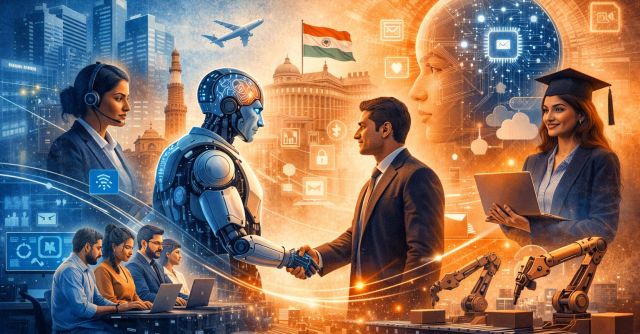
If last year was about AI experimentation, the India AI Summit 2026 — a flagship global gathering hosted by the Government of India under the IndiaAI Mission and held in New Delhi from 16–20 February — signalled something far more concrete: production-grade deployments, sovereign infrastructure, and a decisive shift from global dependency to domestic capability building. The message was clear — India is no longer content being an AI services back office; it aims to build compute, models, applications and enterprise stacks at scale, despite structural constraints ranging from chip dependency and power intensity to uneven R&D depth.
Compute Becomes Core Infrastructure
The centrepiece of the summit was infrastructure. The government reiterated its commitment to sharply expand national GPU capacity under the IndiaAI Mission, positioning compute as a strategic national asset rather than a commercial afterthought.
Global partnerships are reinforcing this push. Nvidia expanded collaborations with Indian enterprises including Reliance Industries, Larsen & Toubro and Tata Consultancy Services to build AI factories and sovereign cloud capabilities.
The infrastructure build-out is also drawing sustained global capital. Microsoft said it is on pace to invest $50 billion by the end of the decade to expand AI capabilities across countries in the Global South. The company had earlier unveiled $17.5 billion worth of AI investments in India last year, reinforcing its long-term bet on one of the world’s fastest-growing digital markets.
Domestic hardware players are also stepping up. Netweb Technologies unveiled ‘Make in India’ AI supercomputing systems powered by Nvidia platforms, underscoring efforts to localise high-performance infrastructure.
For enterprises, the takeaway is clear: access to advanced compute is increasingly becoming available within India’s borders — reducing compliance risk and latency while improving cost visibility.
IT Services Move Up the AI Value Chain
The summit also highlighted a strategic pivot among IT services firms — from integration partners to AI co-builders.
Infosys announced a collaboration with Anthropic to develop enterprise-grade AI agents for telecom, financial services and manufacturing. The focus is on embedding AI directly into enterprise workflows rather than offering generic chat interfaces.
Similarly, HCLSoftware partnered with Sify Technologies to launch a managed sovereign AI stack hosted in India, targeting BFSI, healthcare and government customers where data residency is critical.
This signals a deeper transition: Indian IT firms are repositioning themselves as orchestrators of enterprise AI architecture, not just service vendors.
The Rise of Applied AI Startups
Alongside large enterprise announcements, the summit showcased a growing cohort of domestic AI startups building sector-specific solutions.
Gnani.ai demonstrated multilingual conversational AI designed for banking and telecom operations — reflecting the importance of India’s linguistic diversity in enterprise deployment.
SquadStack.ai announced a collaboration with Nvidia to power its enterprise voice AI platform, Conversational Superintelligence™, built on Nvidia Nemotron. The platform promises hyper-personalised, hyper-contextual voice agents embedded into real enterprise workflows at scale.
Foundation model startup Sarvam AI continued work on sovereign multilingual large language models while expanding into AI-enabled devices.
Other emerging players such as Soket AI Labs, Gan AI and government-backed BharatGen are focusing on multilingual and multimodal foundation models tailored to Indian contexts.
The emphasis is telling. Rather than competing directly with frontier global models, many Indian startups are building vertically integrated AI for specific domains — hiring, voice commerce, financial services and public sector use cases.
Challenges Ahead
Yet the road to sovereign AI will not be frictionless. India remains dependent on imported semiconductor supply chains, AI infrastructure is energy-intensive, and deep-tech capital is still maturing compared with the US and China. Frontier AI research talent remains concentrated in global hubs.
The true test will be execution: converting summit announcements into enterprise-scale revenue, globally competitive intellectual property and sustained R&D depth.
The Bigger Shift
Taken together, the India AI Summit 2026 reflects a structural pivot. AI in India is moving from pilots to production, from services to infrastructure, and from global dependency to calibrated self-reliance — albeit with continued collaboration with global technology majors.
For enterprises, the message is unmistakable: AI is no longer an experimental add-on. It is becoming core infrastructure — embedded not just in software stacks, but in data centres, governance frameworks and real operational workflows.
The next two years will determine whether this ambition translates into a durable advantage.But if the tenor of India AI Summit 2026 is any indication, India’s AI story is moving decisively from promise to production.
Next Article