

How Meesho is rewiring digital commerce with AI at its core
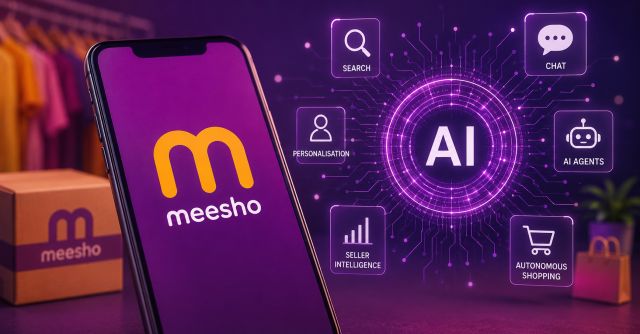
Generative artificial intelligence is no longer being treated as a standalone capability at Meesho. Instead, the e-commerce marketplace is embedding AI across product discovery, seller operations, customer support, engineering and trust systems as it prepares for what it believes will be the next phase of digital commerce—AI-powered autonomous experiences.
While traditional machine learning continues to power recommendations, logistics optimisation and fraud detection, generative AI is enabling Meesho to solve more complex problems involving language, reasoning and human-like interactions, according to Debdoot Mukherjee, Chief Data Scientist and Head of AI.
"We don't see generative AI as a replacement for traditional machine learning. The two complement each other," Mukherjee told TechCircle. "Large language models bring reasoning capabilities, while our proprietary machine learning models contribute marketplace intelligence, behavioural understanding and operational context required to solve commerce problems accurately at scale."
The company's strategy remains firmly data-first. Rather than relying solely on foundation models, Meesho is combining them with proprietary marketplace data and internal AI infrastructure to build production-grade systems designed for India's unique commerce landscape.
That approach underpins products such as PRISM, its AI-powered personalisation engine, Vaani, a multilingual conversational shopping assistant, Chorus, its customer and seller support platform, and TrustMesh, an AI-driven fraud detection platform.
AI becomes part of the engineering stack
Artificial intelligence is also reshaping software development within the company.
Mukherjee said AI now contributes to more than 70% of the code written across Meesho, reflecting how AI-assisted engineering has become part of everyday product development rather than a separate experimentation effort.
Pratik Kumar, Head of Engineering at Meesho, said scaling AI across engineering required investments in production infrastructure rather than isolated model deployments.
The company has built BharatMLStack, an internal AI platform that simplifies model deployment, monitoring and infrastructure management while serving millions of AI inferences reliably and cost-effectively. Kumar said such platforms are essential for moving AI from pilots into production at enterprise scale.
From conversational commerce to AI agents
Meesho expects AI agents to become increasingly autonomous over the next few years.
Instead of assisting with isolated tasks, AI systems will execute complete workflows across shopping, seller operations, customer support and software engineering.
Mukherjee said shopping experiences are becoming increasingly intent-driven, allowing customers to describe products naturally in their preferred language rather than navigating conventional search interfaces.
"We believe we should not have to teach Bharat to talk to machines. We taught machines to understand Bharat," he said.
The company's conversational assistant Vaani allows users to search by describing products in natural language and vernacular languages. According to Meesho, the feature reached more than 1.5 million users within its first month, while customers using it recorded a 22% higher conversion rate.
Beyond shopping, AI agents are expected to help sellers generate catalogues, optimise pricing, create marketing campaigns and resolve operational issues with minimal manual intervention. Internally, AI is increasingly assisting software development, testing, debugging and infrastructure operations.
However, Mukherjee stressed that higher levels of automation will still require orchestration frameworks, governance controls and human oversight for critical decisions.
AI built on Bharat's data
A key differentiator, according to Meesho, lies in the scale and diversity of its proprietary data. The marketplace today serves 274 million annual transacting users, works with more than 1.04 million annual transacting sellers, and processes over 725 million orders every quarter. Those interactions generate billions of behavioural signals spanning shopping, logistics, payments and customer support.
"The real differentiator isn't the model. It's the learning behind it," Mukherjee said. "Billions of marketplace interactions continuously sharpen our understanding of how Bharat shops, sells and transacts."
These datasets power multiple AI systems, from PRISM's recommendation engine and GeoIndia LLM, which interprets India's unstructured addresses, to TrustMesh's fraud detection models and Chorus' multilingual support capabilities.
The company said GeoIndia LLM has improved address geocoding accuracy by 20 percentage points, helping improve delivery precision across India's diverse address formats.
AI governance tied to business outcomes
As enterprises grapple with AI governance and return on investment, Meesho says every model is evaluated against both technical performance and measurable business outcomes before deployment.
Mukherjee said production readiness is assessed through offline benchmarking, controlled online experimentation and continuous production monitoring covering latency, robustness, consistency and cost efficiency.
"At Meesho, a model doesn't ship because it's impressive. It ships because it pays," he said.
Rather than treating ROI as a post-deployment metric, the company integrates business impact into the AI development lifecycle itself, measuring improvements in customer experience, seller productivity, operational efficiency and marketplace performance before scaling deployments.
Looking ahead, Mukherjee believes digital commerce will evolve beyond traditional search interfaces.
"The future of commerce will be defined by intent rather than interfaces," he said. "Customers won't think about whether they are searching, browsing or chatting. They'll simply express what they need, and AI will understand the context, compare options and guide them through the shopping journey."
For Meesho, that future is less about replacing people with AI than using autonomous systems to make commerce feel as natural as interacting with a trusted neighbourhood shopkeeper.
Next Article